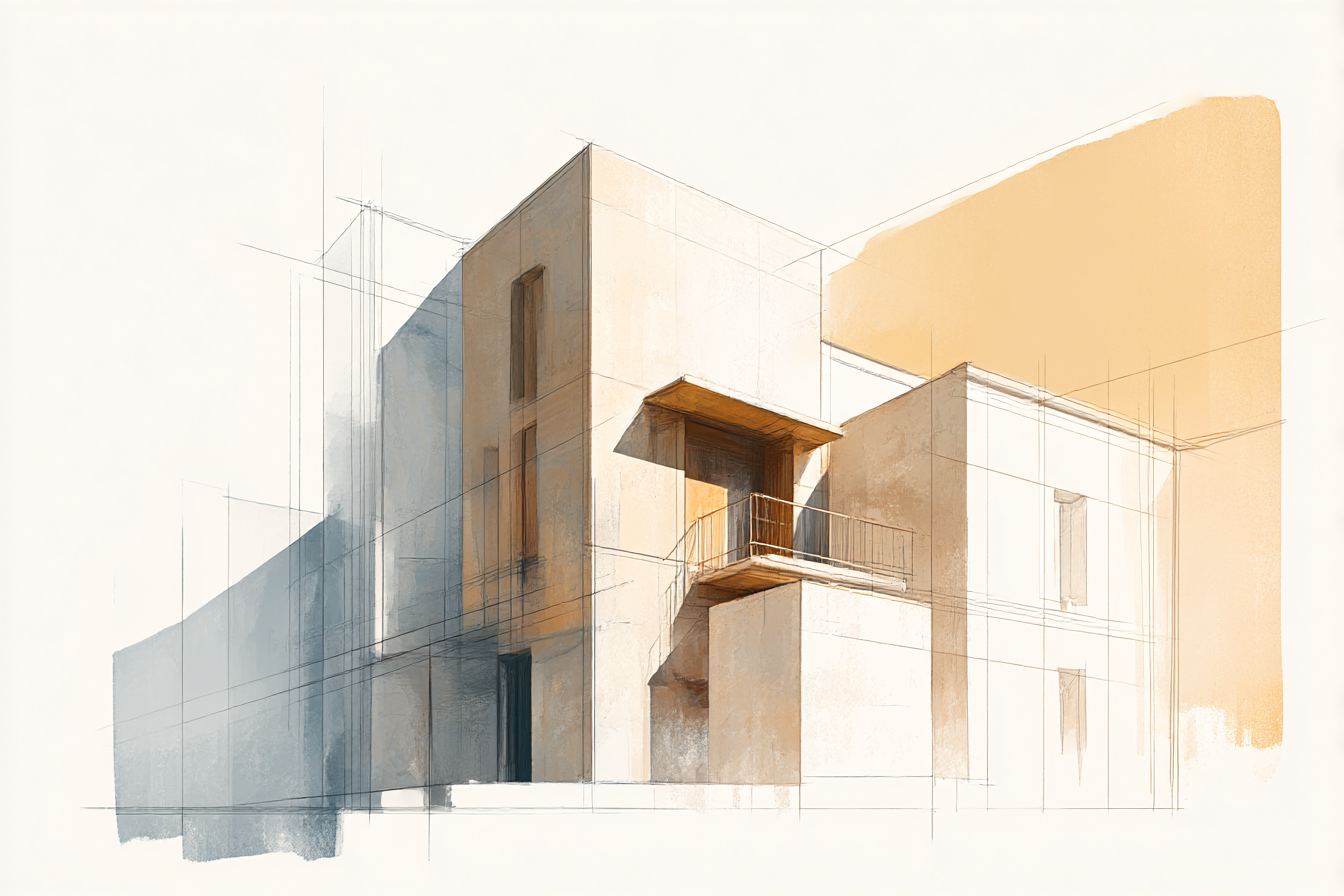
Last Tuesday, I found myself staring at blueprints spread across my kitchen table, coffee growing cold as I tried to explain to a frustrated homeowner why her architect's "sustainable" design was actually going to cost her a fortune in cooling bills. The plans showed a gorgeous modern home with floor-to-ceiling windows facing west, minimal roof overhangs, and what the architect called "climate-responsive materials" – which turned out to be the same concrete and steel you'd find in any generic commercial building.
This happens more than I'd like to admit. Someone hears about sustainable architecture, gets excited about building responsibly, hires a well-meaning professional, and ends up with a structure that fights the desert climate instead of working with it. The problem isn't bad intentions – it's that sustainable building has become this nebulous concept that means everything and nothing at the same time.
You know what really gets me? We've been building sustainably in the Southwest for centuries. The Ancestral Puebloans figured out thermal mass and passive solar orientation a thousand years ago.

Spanish colonial builders understood how thick walls and small windows kept interiors cool. Even my grandfather, who never heard the term "sustainable architecture," designed his garden structures using shade, thermal mass, and natural ventilation that kept them comfortable without any mechanical systems.
But somehow we've convinced ourselves that sustainable building requires exotic materials, complex systems, and certifications that cost more than most people's cars. I've seen "green" homes that needed three different HVAC systems, imported bamboo flooring that failed in our dry climate, and solar panels positioned where they'd be shaded by decorative elements half the day. The owners felt virtuous about building sustainably while their utility bills suggested otherwise.
Real sustainable building starts with understanding your climate, not checking boxes on a certification list. In Phoenix, where I spend most of my time, that means acknowledging we live in a desert that's brutally hot for six months, pleasantly warm for four months, and actually requires heating for maybe two months if we're being generous. Any building approach that ignores this reality isn't sustainable – it's just expensive virtue signaling.
I learned this the hard way working with a developer who wanted to build "the Southwest's first net-zero subdivision." Sounds impressive, right? The marketing was fantastic. The reality was houses oriented randomly on lots (because that maximized the number of units per acre), massive south-facing windows with no shading (because buyers expected lots of natural light), and enough solar panels to power a small factory (because that's what it took to offset the terrible building performance). The houses technically achieved net-zero status, but only by brute-forcing it with oversized renewable energy systems that covered every roof surface and half the yards.
Meanwhile, I was consulting on a custom home in Scottsdale that achieved similar energy performance with a quarter of the solar capacity. The difference? We started with climate-appropriate design. The house was oriented to minimize summer solar gain while maximizing winter sun. Windows were sized and positioned strategically – large north-facing openings for consistent daylight, minimal west-facing glass to avoid afternoon heat, south-facing windows with calculated overhangs that blocked summer sun but allowed winter warmth. The building envelope was designed as a system, with continuous insulation, careful air sealing, and thermal mass positioned where it would actually help moderate temperature swings.
The materials weren't exotic or expensive. We used local concrete block for thermal mass, standard fiberglass insulation installed properly (which is rarer than you'd think), and conventional framing with thermal breaks at critical connections. The roof was basic concrete tile in a light colour – nothing fancy, but it reflected solar heat instead of absorbing it like the dark composition shingles that somehow remain standard in desert construction.
What made it sustainable wasn't the materials themselves but how they were integrated into a system designed for our specific climate conditions. The thermal mass absorbed heat during the day and released it at night when exterior temperatures dropped. The insulation kept that stored thermal energy from escaping too quickly. The roof and wall colours reflected solar radiation instead of turning the building into a heat collector. The window placement and shading eliminated most unwanted heat gain while preserving beneficial natural lighting.
This integrated approach is what most "sustainable" projects miss. They focus on individual components – this insulation, that window, those solar panels – without considering how everything works together in response to local climate patterns. It's like trying to design a car by picking the most efficient engine, the lightest tyres, and the most aerodynamic mirrors without thinking about how they function as a complete vehicle.
I see this constantly in my consulting work. Architects specify triple-pane windows (great for cold climates, overkill and expensive here), super-thick insulation levels (diminishing returns in cooling-dominated buildings), and complex mechanical ventilation systems (unnecessary if you design the building to ventilate naturally). Each component might be "sustainable" in isolation, but together they create an over-engineered, expensive system that doesn't perform significantly better than thoughtful conventional construction.
You Might Also Like

The most sustainable project I've worked on recently was a renovation, not new construction. The clients had a 1980s tract home that was typical for its era – builder-grade everything, minimal insulation, leaky construction, and an HVAC system that ran constantly without achieving consistent comfort. Instead of tearing it down and starting over (which would have been the "green" thing to do according to some perspectives), we developed a systematic retrofit approach.
We started with air sealing, which sounds boring but delivers massive impact. Most homes leak air like sieves, forcing mechanical systems to work harder to maintain comfort. We sealed penetrations through the building envelope, weather-stripped doors and windows, and addressed major leakage points in the attic and crawl space. Cost: about $1,200. Energy savings: roughly 20% immediately, with improved comfort as a bonus.
Next came insulation upgrades, but we were strategic about it. Instead of just adding more insulation everywhere, we identified the most critical thermal bridging points and addressed those first. The biggest impact came from insulating the ducts (which were in unconditioned attic space) and adding a radiant barrier to reduce heat gain through the roof assembly. Again, relatively modest cost with substantial performance improvement.
Window replacement was the most expensive single upgrade, but we approached it systematically. South-facing windows got minimal treatment since they were already well-shaded by existing roof overhangs. West-facing windows, which were creating the most comfort problems, were replaced with high-performance units and supplemented with exterior shading. North windows stayed unchanged since they weren't causing problems. This selective approach saved thousands compared to whole-house window replacement while addressing the actual performance issues.
The HVAC system was right-sized for the improved building envelope, which meant we could install a smaller, more efficient unit that ran less frequently. The old oversized system had been cycling on and off constantly, never achieving steady-state operation. The new properly-sized equipment maintained better comfort while using less energy.
Total project cost was about 40% of what new construction would have been, energy performance ended up being better than most new homes in the area, and the clients love living in a house that actually stays comfortable. That's sustainable building – improving performance through intelligent design and implementation, not through expensive technology or exotic materials.
This experience reinforced something I've been saying for years: the most sustainable building is often the one that already exists, improved thoughtfully. We have millions of homes in the Southwest that could perform dramatically better with relatively modest investments in building envelope improvements and mechanical system upgrades.
But instead of focusing on retrofitting existing stock, most sustainable building attention goes to new construction that represents a tiny fraction of the total building inventory.
I'm not against new construction or advanced building technologies. Some projects genuinely benefit from sophisticated systems and high-performance materials. But the path to widespread sustainable building runs through making conventional construction perform better, not through promoting exotic solutions that only wealthy early adopters can afford.
What frustrates me most is how much misinformation circulates about sustainable building. I regularly encounter homeowners who've been told they need geothermal systems (rarely cost-effective in our climate), cork flooring (performs poorly in low-humidity environments), or straw bale construction (labor-intensive and code-challenging) because these represent "natural" or "sustainable" approaches. Meanwhile, simple strategies like proper solar orientation, appropriate window sizing, and competent air sealing get ignored because they're not sexy enough for marketing materials.
Real sustainable building is mostly about doing conventional things well, with careful attention to climate-appropriate design and quality implementation. It's not particularly glamorous, it doesn't generate exciting press releases, and it doesn't require expensive certifications. But it works, it's affordable, and it can be applied broadly across the existing building stock.
That's the kind of sustainable building I'm trying to promote through my work – practical, performance-focused, and accessible to regular people dealing with real budgets and actual climate conditions. Because ultimately, sustainability isn't about perfect theoretical solutions; it's about making better choices that can be implemented widely enough to matter.