Walking into a friend's corporate office last Tuesday, I couldn't help but notice how the space made me feel instantly drained. Sterile white walls, harsh fluorescent lighting, and not a single natural element in sight – it was like stepping into a sensory deprivation chamber. But then I remembered my first encounter with what I now understand as biophilic patterns, and how dramatically they can transform our experience of indoor spaces.
You know how some wallpapers just make you feel… off? Like there's something slightly wrong but you can't quite put your finger on it? I encountered this phenomenon firsthand during a project renovation about three years ago. The client had insisted on keeping their existing wallpaper – a geometric pattern that looked modern enough but felt somehow aggressive.
Every time I walked into that room, my shoulders would tense up without me realising it.
The breakthrough came when I started studying recurring motifs in nature more systematically. Turns out, our brains are hardwired to respond positively to certain mathematical relationships found throughout the natural world. Fibonacci spirals, fractal branching, organic curves – these aren't just pretty to look at, they actually trigger measurable physiological responses that promote relaxation and focus.
I remember the first time I really grasped this concept. I was sitting in my dentist's waiting room (because where else do life revelations happen?), staring at this awful abstract painting of jagged lines and harsh angles. My heart rate was already elevated from anticipating the appointment, but I noticed how much worse I felt looking at that particular artwork. Meanwhile, the small succulent arrangement on the reception desk – with its gentle spiraling leaf patterns – seemed to have the opposite effect.
That's when it clicked. We're not just talking about slapping some leaf shapes onto fabric and calling it nature-inspired design. Real biophilic patterns mirror the mathematical principles that govern how things grow and organise in the natural world. These patterns have been around for millions of years, and our brains have evolved to find them inherently soothing and engaging.
Take fractals, for instance. I've become slightly obsessed with documenting them – probably to an unhealthy degree. My phone is filled with photos of tree bark, cloud formations, coastline erosions, and leaf vein structures. All sharing this amazing property where similar patterns repeat at different scales. A fern frond looks remarkably similar whether you're viewing the whole plant or zooming in on a tiny leaflet. This self-similarity shows up everywhere in nature, and when we incorporate it into design, people respond instinctively.
The most successful biophilic pattern integration I've witnessed happened in a pediatric therapy centre where I consulted last year. The original space featured standard institutional carpet – you know the type, designed to hide stains and last forever while being as visually neutral as possible. The therapists reported constant struggles with children having difficulty focusing and parents seeming anxious during sessions.
We introduced what I call "pattern layering" – multiple scales of nature-inspired motifs working together. The new carpet featured a subtle river-like meandering pattern that mimicked how water flows around obstacles. Wall graphics incorporated fractal tree silhouettes at varying scales. Even the ceiling tiles got replaced with panels that echoed cloud formations through gentle, organic curves.
The transformation was remarkable. Session attendance improved, children engaged more readily with activities, and the therapy staff noted a significant decrease in behavioral challenges. One therapist mentioned that she found herself staying later in the evenings just because the space felt more comfortable. That's the power of getting these patterns right – they work on a subconscious level.
You Might Also Like
But here's where it gets tricky. Not all natural patterns translate well to interior applications. I learned this the hard way during a residential project where I got a bit too enthusiastic about incorporating honeycomb hexagons throughout a kitchen design. Hexagons appear frequently in nature – from bee colonies to crystal structures to turtle shells – so I figured they'd be perfect for creating that biophilic connection.
Wrong. The repetitive, geometric nature of hexagonal patterns, while natural in origin, can actually feel overwhelming and rigid when applied extensively in living spaces. The client complained of feeling "trapped in a beehive" and we had to dial back the pattern significantly. It taught me that successful biophilic pattern use requires understanding not just what exists in nature, but how human perception processes different types of visual information.
The key lies in balance and variation. Nature rarely presents perfectly uniform patterns – there's always some element of randomness or asymmetry that keeps things interesting. When I design pattern applications now, I deliberately introduce slight irregularities that mirror how natural systems actually develop. A leaf pattern might have some leaves slightly larger than others, or a wave motif might vary in amplitude rather than maintaining perfect consistency.
Colour plays a huge role too. I've found that biophilic patterns work best when they employ colour relationships found in natural environments. Not just greens and browns – though those certainly have their place – but the subtle colour progressions you see in things like sunset clouds or autumn foliage. These gradual transitions feel more organic than stark contrasts and help create that sense of connection to natural processes.
Texture becomes crucial when translating these patterns into physical spaces. A tree-bark pattern printed on smooth vinyl will never have the same impact as one that incorporates actual textural variation. I've started working with craftspeople who can create surface treatments that capture not just the visual aspect of natural patterns but some of their tactile qualities as well.
Scale relationships matter enormously.
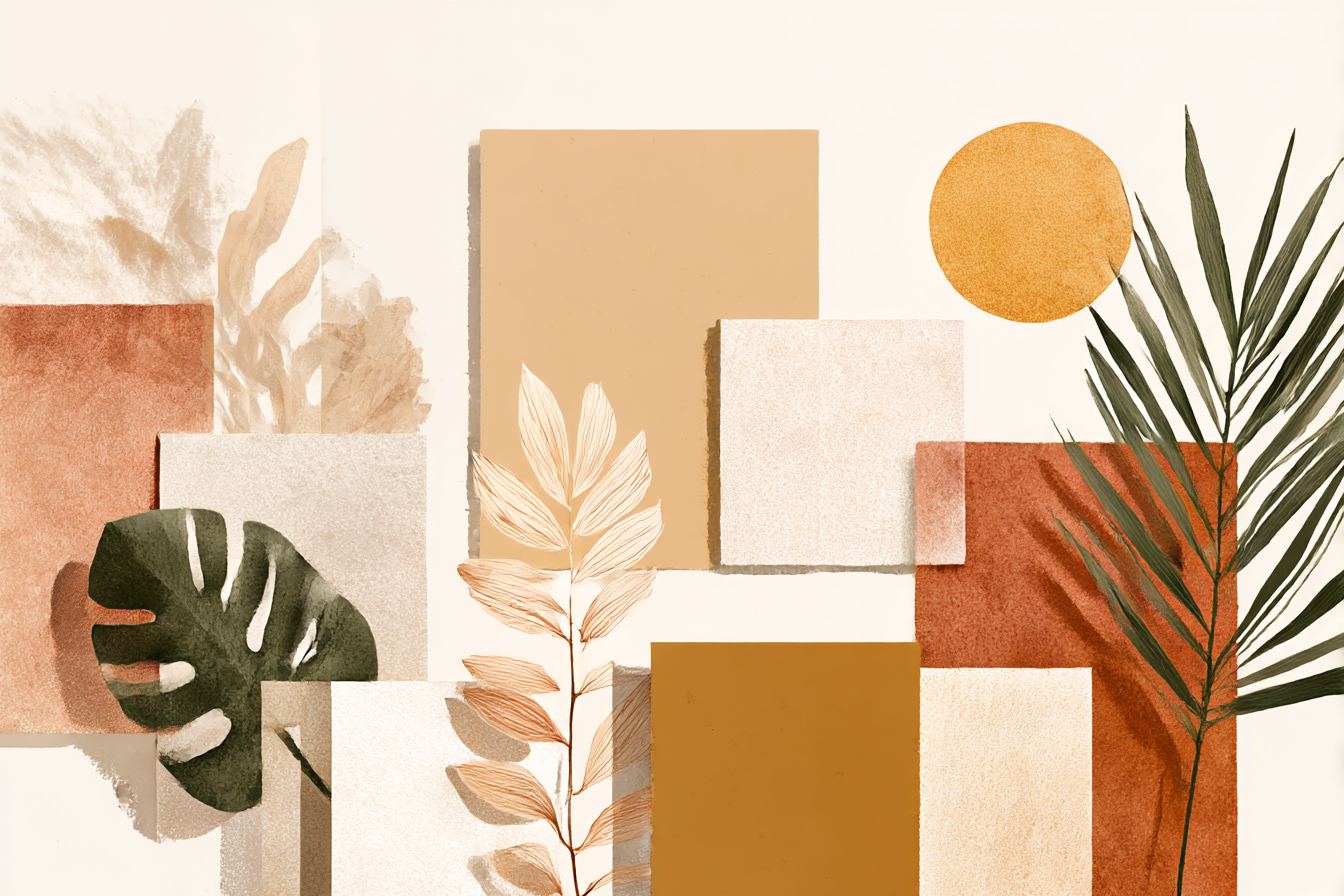
In nature, patterns typically exist at multiple scales simultaneously – think about how a forest has the large-scale pattern of tree placement, medium-scale patterns of branch structures, and fine-scale patterns of leaf arrangements. Successful biophilic pattern design incorporates this same hierarchical organization, giving the eye multiple levels of detail to explore.
The most rewarding part of this work is seeing how people respond unconsciously to well-executed biophilic patterns. During a recent office renovation, I watched employees naturally gravitate toward a conference room we'd designed with subtle wave-like carpet patterns and organic ceiling textures. They couldn't articulate why, but that room consistently got booked for longer meetings and creative brainstorming sessions.
This isn't just feel-good design theory – the research backing these effects continues to grow. Studies measuring stress hormones, attention span, and even immune function consistently show improvements when people spend time in environments incorporating natural patterns. We're not talking about massive changes, but consistent, measurable benefits that compound over time.
Moving forward, I'm particularly excited about how technology might allow us to create dynamic biophilic patterns that change throughout the day or seasons, mimicking the temporal variations we experience in natural settings. Static patterns are good, but patterns that subtly shift and evolve could create even deeper connections to natural rhythms.
The goal isn't to recreate nature indoors – that's impossible and often looks forced anyway. It's about capturing the underlying organizational principles that make natural environments so inherently appealing and restful to human beings, then translating those principles into design applications that work within our built environments.