As someone who has worked on water feature installations in offices, retail and health care for 15 years, I can say that they are very beneficial, but also the most likely way for a biophilic design project to go off track.
A water element looks simple enough to be added to almost any biophilic design strategy. You put a fountain or water wall in a room, people relax and feel less stressed, and the air quality improves slightly, and everyone wins. Except when maintenance turns into a chore, and the water feature becomes a source of additional stress rather than a way to reduce stress.
This article outlines the benefits of installing a water feature, the costs associated with installing a water feature, and perhaps most importantly whether a water feature is the best choice for your particular use-case scenario.

What Water Features Do (Science)
Stress reduction: Water elements reduce stress levels and improve overall wellbeing, with users exhibiting reduced physiological stress markers, improved concentrations, and restored memory in environments with indoor water features simulating natural flow. Biophilic water installations lower cortisol levels by 15-20% per environmental psychology case studies. While that may not be a huge difference, it is still a measurable benefit.
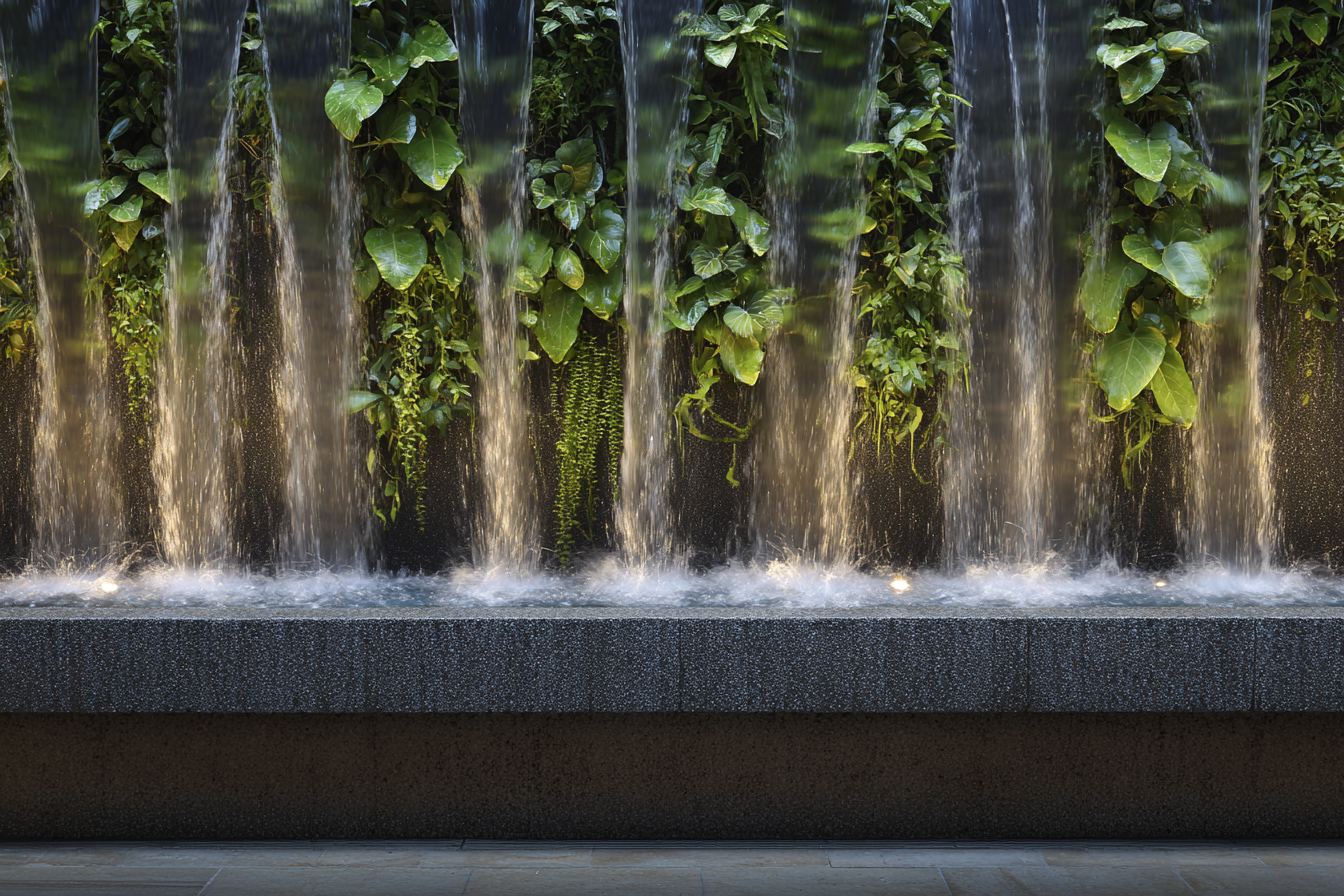
Health outcomes: Hospitals that install water walls have seen post-operative patients recover 8.5% faster and require 22% less pain medication. Those numbers are large and demonstrate the ability of biophilic water features to positively impact patient outcomes.
Productivity and focus: Workplaces with water features report increased productivity and focus due to the auditory masking effect providing a 10-15 decibel reduction in background noise. That is the often overlooked benefit of water features. In areas with high amounts of background noise (i.e., open plan offices, urban areas), the sound of running water provides a mask to help workers stay focused.
Types of Water Features: What Works Where
There are many types of water features available. Some are better suited to certain applications than others.
| Feature Type | Initial Cost | Monthly Maintenance | Complexity | Maintenance Frequency | Best Use | Risk Level |
|---|---|---|---|---|---|---|
| Tabletop Fountain | £50-200 | £0 (you refill) | Low | Weekly refilling, monthly cleaning | Small spaces, residential, low commitment | Low—simple, but requires discipline |
| Wall Mounted Fountain | £200-800 | £20-50 (if serviced) | Medium | Weekly refilling, monthly pump cheque | Office space, retail, medium commitment | Medium—more complex water management |
| Recirculating Waterfall | £500-2,000 | £50-150 (serviced) | High | 2-3 times weekly cheques, monthly filter changes | Large commercial, institutional, long-term investment | Medium-High—pump failure costs are high |
| Living Water Wall | £3,000-8,000 | £150-300 (serviced) | Very high | Daily monitoring, weekly cleaning, monthly maintenance | Large commercial, institutional, serious commitment | High—system failures are expensive |
| Pond/Indoor Pool Feature | £5,000-20,000+ | £300-800 (serviced) | Very high | Daily/weekly monitoring, regular chemical balancing | Luxury residential, corporate headquarters, large investment | Very high—requires dedicated staff |
Honestly: Most people drastically overestimate their maintenance capabilities. A simple tabletop fountain seems like an easy fix, until you realise that you need to refill it 2-3 times a week, algae starts to grow in the water, mineral deposits start forming on the surfaces, and the pump starts to clog if you don’t clean it regularly.

Maintenance Reality: What Actually Happens
This is the part where most water features fail. People install them, they look nice for three months, and then the maintenance required to keep them functioning becomes cumbersome and they’re eventually neglected.
Weekly tasks:
- Refill water (depending on size and location, evaporation could lose 1-3 litres per week)
- Visual inspection for algae growth, mineral build-up, or pump failure
- Listen for abnormal pump noises
Monthly tasks:
- Clean surfaces (mineral deposits, algae, dust)
- Replace or clean filters
- Cheque water quality if using additives
- Inspect pump and tubing for damage
Quarterly tasks:
- Deep clean the entire system
- Inspect all connections and seals for leaks
- Test pump performance
- Plan for seasonal adjustments
Annual tasks:
- Professional servicing of any complex systems
- Drain and refill completely
- Inspect structural integrity
Most people won’t do this. They’ll do it for a month, and then they’ll let it go. Then the pump will fail, the water will become stagnant, algae will bloom, and what was supposed to be a relaxing feature becomes an ugly reminder that they should have never installed it.
Cost Analysis: Is It Worth It?
The table below shows several scenarios for installing water features and estimates the initial costs, total costs over 3 years and 5 years, and the return on investment (ROI).
| Scenario | Feature Type | Year 1 Cost | Year 3 Total | Year 5 Total | ROI Assessment |
|---|---|---|---|---|---|
| DIY maintenance, residential | Tabletop fountain | £100 (initial) | £200 (refill/cleaning supplies) | £300 | Low cost, but high risk of failure |
| Professional service, office | Wall fountain | £500 (initial) + £50/month | £2,300 | £4,500 | Moderate ROI, justified by maintenance |
| Commercial installation | Recirculating waterfall | £1,500 + £100/month | £5,100 | £8,700 | Good ROI if used strategically (noise masking, guest experience) |
| Premium installation | Living water wall | £5,000 + £200/month | £12,200 | £17,500 | High initial investment, justifiable only in hospitality/healthcare/corporate |
The key takeaway is that if you are hiring a third-party to perform professional maintenance on your water feature, that cost can be significant (£50-300/month depending on how complex your water feature is). Additionally, if you are performing DIY maintenance and you miss a few weeks of maintenance, your water feature becomes useless or worse, it becomes a nuisance (stagnant water, algae, bad odour).
Benefits of water features include stress reduction (15-20%), noise masking, and aesthetic value. All of these benefits can be realised if the water feature is maintained correctly.
When Water Features Work
Offices with dedicated maintenance personnel: If a company has a facilities team or a service agreement for its water feature, it will provide a tangible benefit to employees. The benefits of having a water feature in an office space include increased productivity, stress reduction, and noise masking in an open-plan environment. Worth it.
Healthcare settings: Reduced recovery time for patients (8.5%) and reduced pain medication usage (22%) in hospitals with water walls make the installation and maintenance of these features a worthwhile investment. These benefits are substantial.
Hospitality/luxury residences: Guests are willing to pay 23% more for accommodations with views of water features. This demonstrates that guests place a premium on these amenities.
Urban offices: Noise masking (10-15 dB reduction) is a practical solution for businesses located in high-noise urban areas. If the space is otherwise stressful, a water feature would be a good addition.

Failure Points
Residential installations: Homeowners are unlikely to perform consistent maintenance on water features. Therefore, the feature will eventually be neglected and a source of disappointment.
Small commercial installations: Businesses without dedicated maintenance teams will struggle to keep their water features in working order. Good intention, poor execution.
Leases: Landlords will have little to no motivation to perform maintenance on water features since they do not own them. They will fail quickly.
Alternative Options with Comparable Benefits and Lower Maintenance
If you want to achieve the benefits of a water feature (stress reduction and sound masking) without the maintenance responsibilities:
Nature sounds recordings: £0-50 for a high-quality audio system. Provides 70-80% of the acoustic benefit. No maintenance required.
Air purifiers with water filtration: Provide some humidity and air quality improvement along with noise masking. Maintenance consists of replacing filters (less difficult than changing water in a fountain).
Automated misting systems for living plants: Provide both visual biophilic benefits and some humidity and sound absorption. Easier maintenance than water features.
Acoustic panels designed to look like natural elements: No water, no maintenance. Provides sound control. Not as visually appealing as water features, but serves the same purpose.
All of the above options are cheaper and easier to maintain than water features, yet provide similar psychological benefits.
Where to Begin (If You’re Committed)
Be brutally honest first: Will you actually maintain this feature regularly?
If yes:
Begin small: Try out a tabletop fountain (£100-200) to test your commitment without investing too much.
Give yourself 3 months: See if you are willing to refill the fountain 2-3 times a week and clean it every month.
If you’re uncertain about maintenance:
Skip water features: Invest in plants, lighting and materials instead. All of which provide similar benefits to water features with significantly less maintenance.
Consider alternatives: Use nature sounds or sound-masking systems to get 70-80% of the acoustic benefits without managing the water.
Market Growth
The biophilic design market, including water features, is expected to reach £3.14 billion by 2028 at a 10.2% compound annual growth rate (CAGR). The indoor fountains and waterfalls market is expected to grow from £11.9 billion in 2021 to £14.6 billion by year-end projections.
People want them. However, wanting water features and actually taking care of them are two different things.
The Honest Truth
Water features provide real stress reduction, real productivity gains, and real health benefits. If implemented and maintained in the correct environment, water features are definitely worth it.
But unfortunately, water features fail more often than not. They fail when people’s expectations for maintenance-free beauty aren’t met. When water features require maintenance and people don’t take care of them, they will eventually be replaced.
If you are committed to performing maintenance (either yourself or through a service contract), water features can add legitimate value to your space.
If not, spend your budget on other biophilic elements that don’t require active maintenance. Plants, light, natural materials—all of which can provide similar stress reduction benefits with minimal effort.

Marcus has worked in Corporate Facilities Management for fifteen (15) years, prior to working as Workplace Wellbeing Consultant. He has successfully overseen biophilic interior designs in workplaces that include start-up companies and Fortune 500 Companies. As such, he is knowledgeable of the unique challenges associated with incorporating nature into commercial space.
He has developed the ability to execute at-scale: How to develop data-based ROI to demonstrate to CFOs the value of Biophilic Design; How to implement Green Design components within Open-Plan Workplaces in a manner that does not create unnecessary Maintenance Burdens; How to avoid the “Green-Washing” pitfall of using Biophilic Design as merely an expensive form of theatrics versus a Functional Strategy for Employee Wellbeing.
He assists facilities managers, HR personnel and Business Leaders who are interested in improving their employees‘ productivity and retention rates but require understanding of the true costs, timelines and implementation challenges of making those improvements. He approaches his work with a realistic view of what a company will actually maintain and what they will not be able to support. His writing cuts through the hype surrounding Wellness Trends and focuses on achieving Measurable Outcomes and Sustainable Implementation.