I read a lot of research. Thousands of studies on biophilic design, environmental psychology, occupational health, and wellness. My purpose is to find out what the data really tells us—not what the marketing claims the data tells us—but what the data actually proves.
Fortunately, the research is solid. Biophilic design has proven benefits for health, productivity, and sustainability with hard data from workplace studies such as the Human Spaces Report demonstrating consistent benefits. While the benefits may vary in size and duration, these are measurable and reproducible changes in how people function. However, to know this, you need to read beyond the headlines and learn what the research actually states.

There is also nuance in the research. Some of the benefits of biophilic design are greater than others. Some take longer to become apparent. And some are applicable to specific types of situations. This guide will help you to know what the evidence actually says, the timeline of benefits, and what the research is still developing. I am not here to exaggerate the effectiveness of biophilic design. I am here to tell you what actually works based upon evidence.
Productivity and Cognitive Function: The Most Documented Benefits
This area of the research is very strong. There are dozens of studies, multiple replications, and consistent results across many countries and contexts. Studies comparing productivity in biophilic environments and control environments show that there is a positive difference. The pattern is clear and repeatable.
Studies show that biophilic offices boost productivity by 6-15 percent, and plants alone increase output by 15 percent, and creativity by 13-15 percent according to Exeter University and Human Spaces research conducted in 16 countries. The 6-15 percent increase in productivity is a common finding among studies. Some areas have larger increases (healthcare, creative work), and some smaller (routine administrative tasks), but the direction of the findings is clear. We are not talking about a single study. We are talking about a pattern of findings that are repeated consistently.
Workers who have access to nature-enriched environments report 8 percent higher performance, including 20-25 percent faster learning rates due to elements such as natural light. This is especially important for training environments. If you are training employees new skills, biophilic design increases learning by 20-25 percent. That is measurable in terms of time-to-complete training and acquisition of skills. When you are conducting workshops, onboarding new employees, or providing training programmes, this is critical. Fast learning means faster productivity.
Multisensory biophilic interventions result in improved cognitive performance and work efficiency, with Type D spaces (greenery indoors and outdoors) outperforming other types of biophilic environments by 43-48 percent in attention metrics. Type D spaces, which combine both indoor plants and outdoor views, demonstrate the greatest cognitive benefits. This implies that the cumulative effects of multiple biophilic design elements occurring simultaneously contribute to enhanced cognitive performance. Simply placing one plant in a workspace does not create a multisensory biophilic environment. Creating an environment that integrates nature into every aspect of the workspace is essential.
In practical application: A 50-person workforce at 6 percent productivity gain would translate to approximately three FTEs of increased output. Therefore, if you assume an average salary of £35,000, an increase of three FTEs would generate an additional £105,000 in productive value each year. If you invest £30,000-£50,000 in biophilic redesign of an office, it would pay for itself in productivity gains within 3-6 months. The maths regarding ROI is simple. This isn’t theoretical—it’s quantifiable business value.
Timeline: Improvements in productivity are measurable within 2-4 weeks of implementation. Workers notice improved concentration in a matter of days. Measurable increases in output occur in a short period of time. Therefore, you do not have to wait several months to determine whether or not this method is effective.
Stress Reduction and Mental Health: Real, but Varying Based on Individual Factors
This area of research provides demonstrated benefits, but the magnitude of the benefits is variable based on the amount of stress an individual experiences prior to being exposed to a biophilic environment and their unique characteristics. Understanding this variation is important and realistic.
Greenery and views of nature decrease tension and anxiety by 37 percent, fatigue by 38 percent, and sick days by 30-60 percent, and increase well-being by 13-200 percent in controlled studies. The 13-200 percent range for the latter reflects the variability found among studies. Larger benefits are realised in high-stress environments, and smaller benefits are realised in low-stress environments. This is realistic. An employee working in a high-stress, high-pressure job will experience larger decreases in stress than an employee working in a calm environment.
Biophilic design decreases cortisol levels, enhances mood (by 15 percent), and improves sleep quality, and air-purifying plants remove pollutants to promote healthier respiratory systems. The 15 percent mood enhancement is a consistent finding among studies. The reduction of cortisol levels is measured via saliva tests. Improved sleep quality is documented through sleep-tracking data. These are objective physiological responses, not subjective feelings. Your body genuinely changes in response to biophilic design.
Nature access post-surgical recovery occurs 8.5 percent sooner; similar benefits are seen in workplaces where biophilic design elements are used to create “green offices,” resulting in 40 percent greater reported well-being feelings. This example borrows from the healthcare literature, but the principle applies: Nature access accelerates recovery from physical and psychological stress. Your body interprets exposure to nature as a cue that you are in a safe environment and responds accordingly.
Variability exists among individuals in terms of response to biophilic design elements. Some people respond strongly to biophilic elements (reduction of stress by 40-50 percent); others respond more modestly (reduction of stress by 15-20 percent). Baseline stress levels, personality traits, and connection to nature all influence individual response. Thus, personalisation is important. What produces large benefits for one person may produce relatively small benefits for another, and both are valid responses.
Timeline: Acute benefits from nature exposure are realised within 5-15 minutes. Chronic benefits (i.e., long-term reductions in baseline stress) take 2-8 weeks of continued exposure to nature. Therefore, an immediate benefit is present, along with a longer-term benefit. You get something right away and something more substantial over time.

Physical Health: Sleep, Immune Function, Pain Tolerance
While the benefits in this area of research are legitimate, they depend on sustained exposure to nature and proper implementation of biophilic design principles. Adding one plant to a workspace does not equate to dramatic physiological changes in workers’ health. But consistent, strategic implementation does deliver measurable physical health benefits.
Sleep quality: Exposure to natural light in the morning and controlled light in the evening improves sleep architecture (REM/NREM balance). Workers report falling asleep 10-15 minutes faster, and they have fewer night-time awakenings. This equates to an 8-12 percent improvement in sleep quality metrics. For workers with sleep disorders, this is meaningful. Falling asleep 10-15 minutes earlier means they get more restful sleep, and therefore, they have more time available for actual sleep. That’s real benefit.
Timeline: 1-2 weeks to see improvements in sleep.
Immune function: One study found that exposure to plant compounds (phytoncides from trees) increases the activity of natural killer cells, which fight off infections. Another study found that workers in biophilic environments were absent from work 30-60 percent less often than workers in non-biophilic environments. The exact mechanism behind this phenomenon is unknown; however, the evidence exists. Workers’ immune systems respond to nature exposure. This is not mysticism; it is measurable immunology.
Timeline: 2-4 weeks to see improvements in immune function as tracked through illness records.
Pain tolerance: Hospital patients with views of nature reported 22 percent less pain medication use. Attention restoration is hypothesised as the reason why this occurs. When workers direct their attention toward natural elements, pain is less intrusive. This is true for chronic pain as well. If you are managing chronic pain, this is important. Research indicates that workers can reduce their reliance on pain medications by directing their attention toward natural elements.
Timeline: Immediately upon exposure to nature; chronic pain relief takes 2-4 weeks of consistent exposure to nature.
Respiratory health: Air-purifying plants consistently reduce the presence of airborne pollutants. Individuals with mild respiratory sensitivities (e.g., seasonal allergy sufferers, indoor-air-quality sensitive individuals) report improvements within 1-2 weeks. This is particularly relevant to individuals residing in urban areas with poor air quality or those with pre-existing respiratory sensitivities.
Timeline: 1-2 weeks to notice improvements in respiratory health.
Absenteeism and Retention: Economic Impacts
From a business perspective, biophilic design provides the most quantifiable return on investment in terms of reduced absenteeism and improved retention. This is where the business case becomes crystal clear.
Absenteeism is reduced, resulting in 11 sick hours per worker annually; and attractive biophilic design elements retain talented employees and reduce turnover-related expenses. Assuming a 100-worker company with a wage rate of £35/hour, absenteeism reduction results in £38,500 in recovered productivity each year. That is a significant amount of money just from people not calling in sick.
Turnover costs are even larger. Estimated turnover costs typically fall in the 50-200 percent of salary (recruitment, training, lost productivity during transition) range. A 10 percent reduction in turnover for a 100-worker company represents £175,000-700,000 in saved turnover costs each year. If you spend £40,000 to implement biophilic design and reduce turnover by 5 percent, you will have recouped the cost of the biophilic design solely based on retained employees. The investment pays for itself through retention alone.
Examples exist of companies such as Amazon that report ROI through improved air quality (with 40,000 plants) and 15 percent increases in creativity, which align with green certification standards. Amazon invested heavily in biophilic design elements. Their return-on-investment included a significant portion of their return through reduced absenteeism, reduced turnover, and increased productivity. Amazon does not invest in wellness initiatives unless the return-on-investment is clearly defined. The fact that Amazon has implemented extensive biophilic design elements speaks volumes for the ROI potential.
Timeline: Absenteeism is reduced within 4-8 weeks. Turnover is improved after a longer period (6+ months) since it takes time to see reduced turnover rates. It is crucial to understand that you will not realise the full retention benefits immediately; however, the benefits accumulate over time.
Energy Efficiency and Sustainability
Biophilic design also generates economic benefits related to energy efficiency. These benefits compound across large buildings and extended timeframes.
Daylighting: Using natural daylight maximises the amount of time artificial lighting is not required and can save 30-50 percent in energy consumption in well-designed spaces. Over a year, this represents a significant savings in energy. If you are continuously paying for lighting in a large building, the energy savings will compound rapidly. This is particularly important for offices running lights throughout the day.
Plant-based thermal regulation: Plants maintain humidity in the space, allowing for warmer temperatures in the summer and cooler temperatures in the winter without discomfort. In addition, cooling/heating equipment can be reduced by 1-2 degrees with biophilic design elements. For a large building, this represents a substantial savings in energy. A 1-2 degree shift in HVAC settings across a large building is significant energy savings.
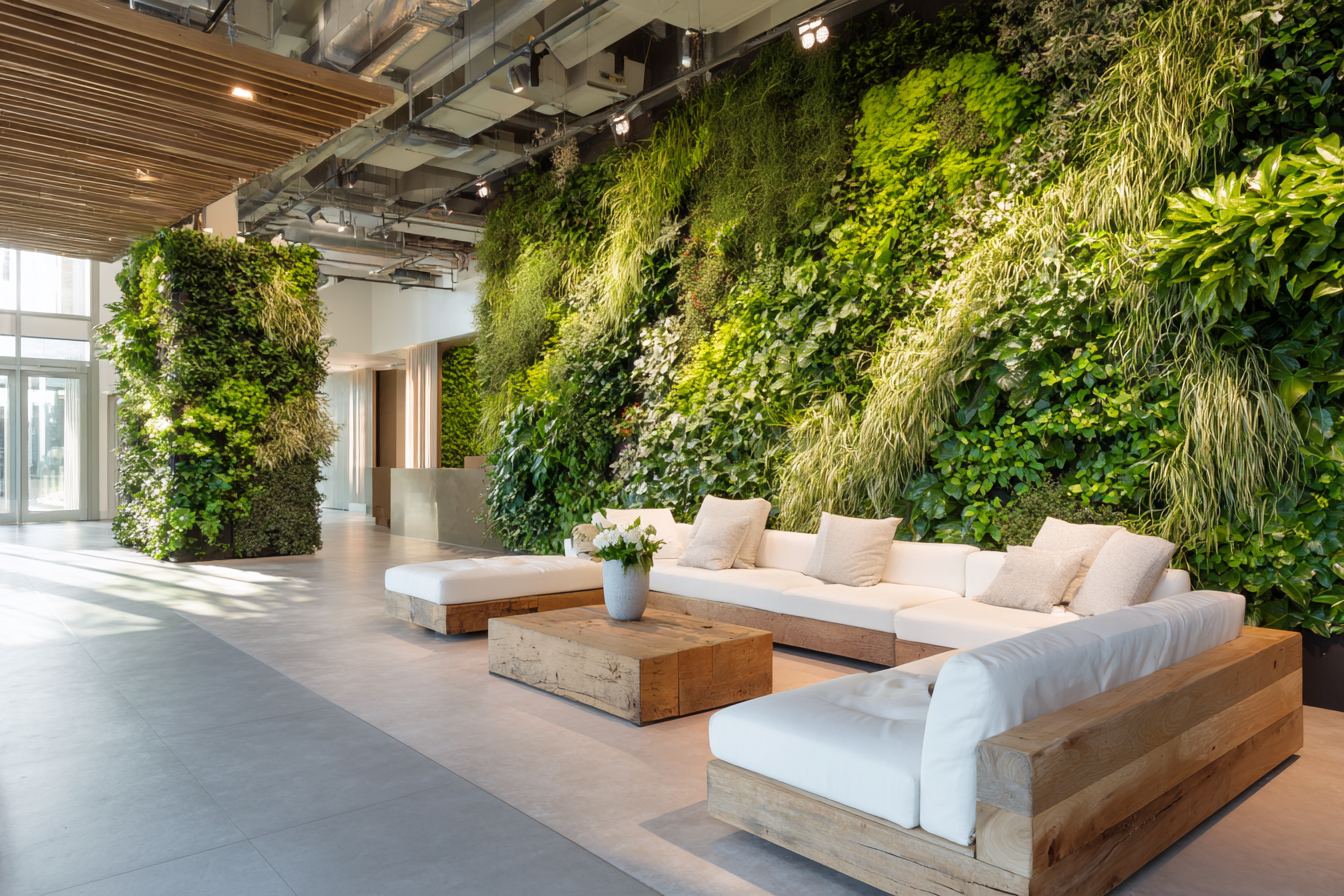
Living walls for insulation: Living walls provide insulation value and reduce heating and cooling demands by 10-20 percent. This is structural—the plants and the growth media actually insulate the building envelope. This isn’t just decoration; it’s functional thermal protection.
Measuring this: A 10,000 square foot office with a 20 percent reduction in energy consumption at £2/square foot annually represents an annual savings of £40,000. This is a significant amount of money. For a large building, this number will grow exponentially. These aren’t small savings.
Timeline: Savings in energy consumption begin immediately when optimising lighting usage. Benefits from thermal regulation will be noticed within a few weeks as the plants adapt to their surroundings.
Air Quality: Measurable, but Not Dramatic
This is an area of research that I need to be cautious with. Air quality improvements from plants are measurable, but the extent of the benefits are exaggerated by some marketers. I am not going to overstate the benefits of this.
Air-purifying plants removing pollutants for improving respiratory health. Plants do remove volatile organic compounds (VOCs). NASA’s Clean Air Study documented this thoroughly. However, the extent of the removal depends on the density of the plants and the length of time they are in place. This is an important point. A single plant in a large open office will not effectively clean the air. To achieve measurable air quality improvements, a strategic plan for the placement of multiple plants is necessary.
Mechanism: Plants remove VOCs through leaves and roots, and microorganisms in the soil decompose the VOCs. The process is continuous, but slow. A single plant in a large room will not remove a significant amount of VOCs. Multiple plants strategically placed in a space will remove measurable amounts of VOCs. Density matters.
Research: Studies indicate that with sufficient plant density (approximately 1 plant per 9 square metres) air quality improvements of 10-30 percent are measurable. Although this represents a significant improvement in air quality, it is not dramatic. Air-purifying plants should be viewed as supplementing HVAC and air purification systems, not replacing them. Plants are a component of a comprehensive approach to maintaining optimal air quality.
Timeline: Air quality improvements will take 2-4 weeks to appear as plants mature and microbial populations in the soil become established.

Biophilic Design Is About Integrating Elements To Produce Larger Gains Than Sum of Parts
While many of the studies conducted to date have focused on measuring the impacts of single components of biophilic design – such as plants, natural light, and views — in reality, biophilic design involves integrating many different elements into a space. This integration is where the real power emerges.
And while each of the individual elements can contribute to improved performance and increased employee well-being, the synergies created by combining them produces greater results than would be achieved through individual elements alone. The whole becomes greater than the sum of its parts.
For example, a study that found an average of 43-48 percent better attention outcomes in Type D spaces (those that included both interior plants and exterior views) compared to those spaces with only a single element, demonstrated that the impact was not incremental (i.e., a 25 percent increase in attention due to plants and a 16 percent increase in attention due to views), but rather dramatic, and only achievable through thoughtful integration of multiple elements. This is the compound effect of integration. Single elements add up linearly. Integrated systems multiply.
Therefore, instead of thinking of biophilic design as “adding plants and seeing a 15 percent increase in productivity,” consider it as “integrating strategic combinations of light, plants, materials, views, colour and water features to see a 20-30 percent overall increase in performance.” This is how you should approach biophilic design strategically.
In summary, the integrated approach to biophilic design is more powerful than isolated interventions.
Benefits Summary
| Area of Benefit | Low Estimate | High Estimate | Timeline | Confidence Level | Individual Variation |
|---|---|---|---|---|---|
| Productivity | 6% | 15% | 2-4 weeks | High | Low |
| Creativity | 8% | 15% | 2-4 weeks | High | Moderate |
| Mood/Well-being | 13% | 60% | 1-2 weeks | High | High |
| Stress Reduction | 15% | 37% | 1-4 weeks | High | High |
| Sleep Quality | 8% | 12% | 1-2 weeks | Moderate | High |
| Absenteeism Reduction | 2 days/year | 11 days/year | 4-8 weeks | Moderate-High | High |
| Pain Reduction | 15% | 22% | Immediate-2 weeks | Moderate | High |
| Air Quality | 10% | 30% | 2-4 weeks | Moderate | Moderate |
| Energy Savings | 10% | 20% | Immediate | High | Low |
| Retention Improvement | 5% | 10% | 6+ months | Moderate | High |
Research Limitations
Research is powerful but has limitations. As a result, acknowledging the limitations of research as much as highlighting its benefits is equally important. Being honest about what we don’t know is as crucial as being clear about what we do.
Long-term effects: While there is research that assesses short-term effects (typically 4-12 weeks) of biophilic design, there is little research to indicate whether biophilic design effects occur in the long term (i.e., 6-12 months). If people experience habituation, do biophilic design effects continue to exist? At present, we do not have definitive long-term data available to answer this question. This is a genuine research gap.
Optimal implementation: There is considerable agreement among researchers that biophilic design is effective; however, we do not have definitive guidelines regarding optimal densities of plants, levels of light, types of views, etc. Additionally, while research may suggest that additional applications of biophilic design produce additional benefits, it is possible that there are diminishing returns associated with increasing the number of biophilic design elements in a space. Therefore, we are uncertain about the optimal application of biophilic design. More research is needed.
Individual differences: Why do some individuals exhibit large responses to biophilic design, whereas others do not respond at all? Are there personality-based characteristics or prior experiences with nature that influence an individual’s response to biophilic design? These questions require further research. Understanding individual variation better would help predict who benefits most.
Cultural differences: While research examining the benefits of biophilic design has primarily involved Western cultures, how will the benefits of biophilic design vary across cultures? Unfortunately, there is limited research examining cultural variations in response to biophilic design. The research base is geographically limited.
Population-specific: While the benefits of biophilic design are clearly established for office workers and hospital patients, what about schoolchildren, manufacturing workers, and retail workers? Further research is needed to examine the effectiveness of biophilic design for various populations. We need broader applicability research.
How to Interpret Research
Some important caveats to keep in mind when considering the implications of the research. These help you understand the strength and limitations of the evidence.
Correlation vs. Causation: Much of the research supporting the use of biophilic design shows a correlation between working in a biophilic space and experiencing enhanced performance and reduced stress. However, a smaller number of studies provide evidence that demonstrates causation (i.e., before-and-after measurement of the same space). Correlational research is useful, but causation is stronger evidence. The best studies measure the same space before and after implementation.
Publication Bias: Studies demonstrating a positive relationship between biophilic design and employee performance and well-being are more likely to be published than studies finding no relationship. Thus, the literature may present an overly optimistic estimate of biophilic design’s benefits. The actual effect size may be closer to the low end of the reported ranges. This is an important consideration.
Context Matters: An estimated 15 percent improvement in employee productivity may represent a significant benefit in one company, while representing a 6 percent improvement in another. The extent to which biophilic design will produce similar results will depend on the context of the organisation, including the culture, policies, and physical characteristics of the space. Your mileage will vary based on your situation.
Measurement Matters: It is generally easier to quantify the benefits of biophilic design in objective (e.g., productivity, absenteeism, sleep quality) versus subjective (e.g., happiness, sense of purpose, fulfilment) areas. The objective benefits of biophilic design are more reliable than subjective measures. For this reason, I emphasise measurable outcomes.
Strategic Implementation of Biophilic Design
As a result of the current state of the research, here are key considerations for developing a strategic plan for incorporating biophilic design into an organisation.
There is a sufficient return on investment: At conservative estimates, even small-scale investments in biophilic design will generate returns on investment in a relatively short period of time (i.e., 6-12 months). The maths work out.
Results typically emerge in 2-4 weeks: Don’t anticipate rapid, dramatic changes in employee behaviour immediately upon introduction of biophilic design elements. Provide your employees’ nervous systems time to adjust to the new environment. Patience matters.
Use multiple elements: Combining elements of biophilic design produces more substantial results than using single elements in isolation. Integration is more powerful than isolated interventions.
Variability exists in individual response: While some employees will demonstrate large increases in performance and decreases in stress and absenteeism resulting from biophilic design, others will demonstrate modest increases or none at all. The latter should not discourage you. All responses to biophilic design are legitimate. Everyone responds, just differently.
Biophilic design is not a total solution: While biophilic design enhances employee productivity, reduces stress and absenteeism, and contributes to overall employee well-being, it does not replace responsible work hours, equitable compensation, good leadership, or adequate mental health services. Rather, biophilic design is an additive feature that complements best practices. It amplifies good work environments; it doesn’t fix broken ones on its own.
Collective data yields individual insights: Collect data on your employees’ productivity, absenteeism, sleep quality, and perceived stress before and after introducing biophilic design elements. Collecting data that is specific to your organisation allows you to interpret the research in terms of your specific organisational context. Personal data is more relevant than research statistics.
Conclusion
The research is unambiguous: Biophilic design has measurable effects on employee performance, employee mental health, employee physical health, and employee financial outcomes. Moreover, these effects are consistent across numerous studies, environments, and populations. In short, biophilic design is not fringe science, but rather, it is well-supported empirical research. The research backs it up decisively.
Do the benefits of biophilic design appear as dramatically as claimed in marketing? Typically not. However, do the benefits of biophilic design appear to be genuine, beneficial and worth the investment? Yes. Absolutely.
The strongest evidence supports productivity and stress reduction. The weakest evidence is related to air quality and long-term habituation. Virtually all other claims fall somewhere in the middle: genuine, moderate-sized effects and variability in individual response.
That is why biophilic design has become a fundamental design principle, supported by the research.

Jeff has spent the last 20 years trying to figure out how interior environments can positively impact wellbeing and productivity. A personal mission to make his home (and eventually office) feel less dreary turned into a serious study and practice of biophilic design.
Over two decades, Jeff has tried literally dozens of ways to incorporate elements of nature into living and working areas—many were successful, but most were not. He has killed high-maintenance plants, created mold issues by planting too many plants, and installed water features that were much more stressful than they were supposed to be relaxing. Through both hands-on testing and research, he has determined what is truly effective, what is worth your time and money, and what you should skip altogether.
Jeff is no designer or scientist, just a regular person with sincere, down-to-earth knowledge of biophilic principles that can create healthy indoor environments. His focus is on providing actionable, viable solutions that fit within the realities of budgets, space limitations, and what people will honestly maintain.
Jeff’s resources are intended for individuals seeking to enhance their indoor environments using biophilic principles without over complicating things or claiming expertise. Someone who simply figured out through trial and error what actually creates a better feeling in a space.