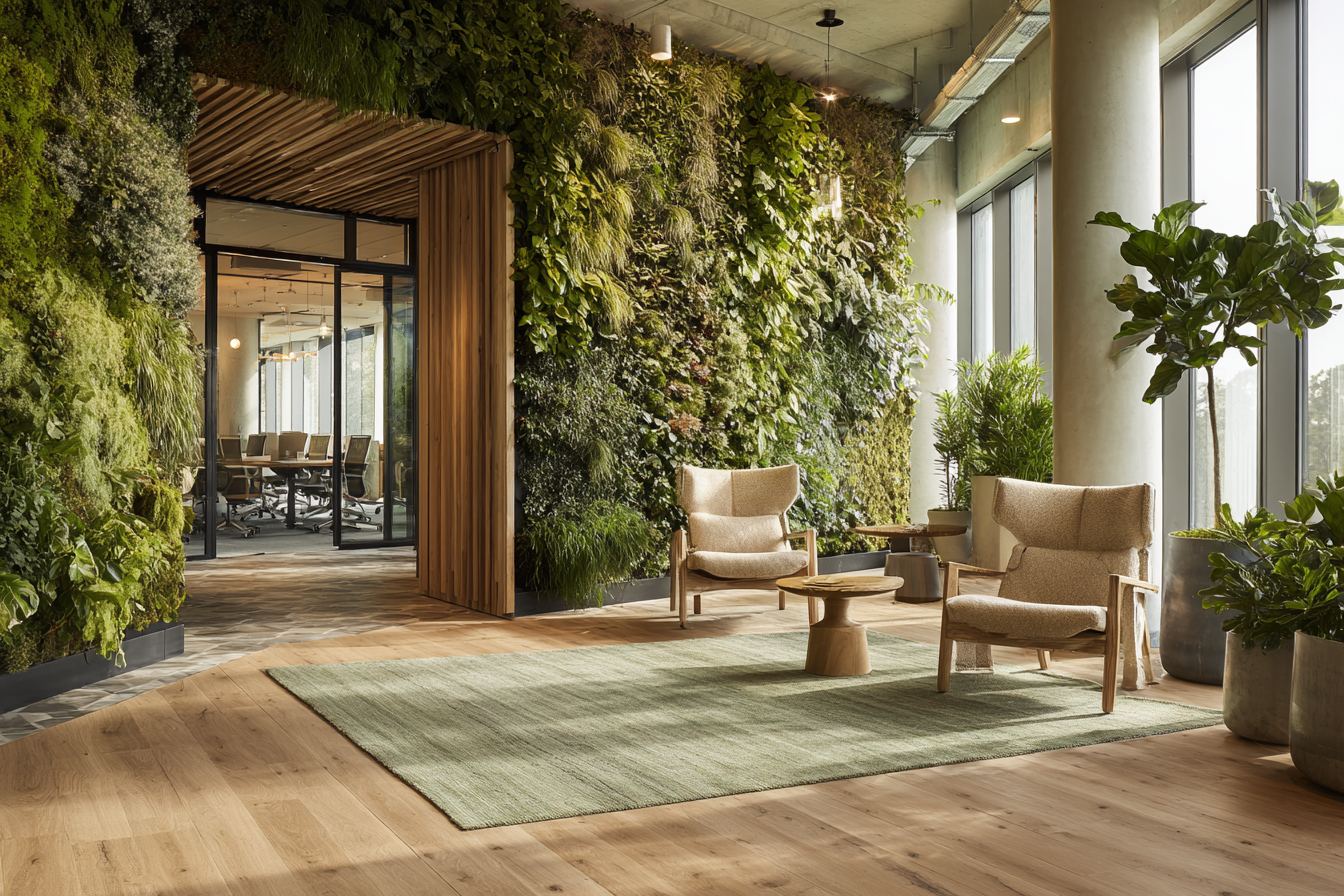
I have worked with organisations for 15 years developing and implementing biophilic design as part of their workplace strategy, and I believe I am seeing a fundamental shift in the way we discuss and implement biophilic offices. Just 10 years ago, biophilic offices were considered a ‘wellness luxury’ for those businesses wishing to provide the very best for their employees. Today however, providing employees with access to natural elements in their workspace is no longer a nicety – it’s a requirement for organisations seeking to remain competitive.
The research shows us that biophilic design enables organisations to create workplaces that promote employee wellbeing, increase productivity, and enhance employee retention. However, I regularly speak to business leaders and finance professionals who are unclear on how to successfully implement biophilic design, and therefore unable to quantify the return on investment (ROI).

Many organisations view biophilic design as simply the addition of plants to their offices and perceive the additional expenditure as an unnecessary ‘nice to have’. What they fail to appreciate is the proven link between biophilic design and increased productivity (average 15%), lower employee turnover (average 13%) and the tangible business benefits associated with the latter two metrics.
In this article I will outline the evidence-based business case for biophilic design, explain how to evaluate the effectiveness of biophilic design in an organisation’s workspace and detail the financial ROI associated with biophilic design.
Business Case: What Does the Research Really Say?
To begin with, I will outline the research based evidence supporting biophilic design and the business case behind it. Once you understand the evidence and the business case, the decision to invest in biophilic design will be straightforward.
Research-Based Evidence Supporting Biophilic Design
The business case for biophilic design is supported by research-based evidence that provides the following metrics:
Productivity gains: Biophilic design results in a 15% increase in productivity, with plants alone contributing to 14% increase in output due to enhanced concentration and short-term memory.
Employee health and wellbeing: Employees in nature-enriched spaces demonstrate 6-15% higher creativity and 8% higher productivity due to natural light exposure (Exeter University & Interface).
Absenteeism reduction: Workplaces with a lack of natural light and/or views demonstrate 11 more sick hours per annum than workplaces with biophilic design. Absenteeism is reduced through enhanced air quality and improved focus. Therefore, absent employees equates to lost hours of productivity (typically 2-3 days per employee). For a 50-employee organisation, this represents 100-150 extra working days per annum. At typical salary costs, this equates to £10,000-£20,000 in recoverable productivity due to employees not being absent.
Reduced stress levels: Biophilic design reduces stress levels significantly, resulting in a 40% increase in employee wellbeing. Greenery and views improve perceived air quality, mood and cognitive restoration. Employees experiencing high levels of stress typically perform poorly, are slower to task completion, and cause conflict. Furthermore, they are less creative and less collaborative. Reducing employee stress directly impacts on the quality of work produced and creates a positive working environment for all employees.
Improved talent retention and recruitment: Biophilic design demonstrates significant ROI via improved employee retention and recruitment, with workers in green offices reporting higher motivation and desire to continue working in their current role. The Human Spaces Report across 7 countries found biophilic workplaces 8-15% more productive, with 44% of employees preferring natural light in their workspace. In practical terms, when you’re recruiting new employees, you can state “we’ve invested in biophilic office design.” This has significant value as employees wish to work for employers who value their wellbeing and will therefore seek employment with such organisations.

Evidence-Based Economic ROI: Why Do Large Corporations Invest in Biophilic Design?
Amazon is an excellent example of a large corporation using biophilic design to achieve bottom line gains, with plants and views resulting in 13% wellbeing improvement and reduced lean office drawbacks experienced by employees. Amazon does not invest in office design merely for the sake of having nice looking offices. Rather, Amazon has used biophilic design as a tool to drive business performance, and this is evidenced by the data collected.
Cost-Benefit Calculation: What Is the Financial ROI of Biophilic Design?
To justify investments in office design to finance and leadership teams, you require a solid understanding of the cost-benefit calculation. The calculation should demonstrate clearly what you will receive for every pound invested.
Below is an example of a cost-benefit calculation demonstrating the ROI of biophilic design. Please note that the costs and ROI outlined below are examples and may vary depending upon the specifics of each project.
| Level of Implementation | Total Investment | Annual Ongoing Costs | Impact on Team Size | Productivity Gain (Year 1) | Payback Period |
|---|---|---|---|---|---|
| Minimal (Plants + Light) | £5,000 – £10,000 | £500 – £1,000 | 20-30 employees | £15,000 – £25,000 (15% × Salary Costs) | 4-8 months |
| Moderate (Living Walls + Redesign) | £20,000 – £40,000 | £2,000 – £4,000 | 30-50 employees | £35,000 – £60,000 | 6-12 months |
| Comprehensive (Full Biophilic Redesign) | £50,000 – £100,000+ | £5,000 – £10,000 | 50-100+ employees | £75,000 – £150,000+ | 6-12 months |
The costs outlined above represent the total investment required for each level of implementation. The costs are assumed to be the initial outlay for implementation and include both capital and labour costs. The annual ongoing costs represent the costs incurred post-implementation. The costs have been calculated based on an assumption that the organisation captures just 10-15% of the documented productivity gains available through biophilic design. As previously stated, the organisation may be able to capture more of the documented productivity gains available through biophilic design, depending on factors such as the engagement of employees with the biophilic design implemented.
Biophilic design offers a compelling ROI at all three levels of implementation. The most important aspect of the cost-benefit calculation is the fact that the ROI is achievable regardless of the level of implementation.
Real Example: £30,000 Biophilic Redesign in a 50-Employee Organisation
A £30,000 biophilic redesign in a 50-employee organisation with an average salary (including benefits) of £35,000, will result in a 15% productivity gain equating to 7.5 FTE x £35,000, or £262,500 in productivity value. Based on these figures, the payback period is approximately 1.4 months. All future benefits generated by the biophilic redesign are pure profit.
Using the same assumptions, if the organisation achieves a 5% productivity gain, the productivity value generated is £87,500 per annum. As previously stated, this represents an exceptional ROI.
Making the Business Case for Biophilic Design
The majority of finance directors do not think in terms of productivity gains and retention values. They view a £30,000 office redesign as a cost centre and will not consider the benefits provided by the redesign unless it can be articulated in terms of productivity gains and retention values. Your responsibility in making the business case for biophilic design is to articulate the design investment in terms of productivity gains, retention values, recruitment, and revenue.
Implementation Framework: What Actually Works at Scale
I have witnessed numerous biophilic offices implemented successfully and numerous biophilic offices implemented poorly. The difference between successful and unsuccessful biophilic offices is not chance — it is based upon the use of a structured approach to implementing biophilic design. When you have a structured approach to implementing biophilic design, the process is much clearer and the chances of achieving the desired outcome are greatly increased.
Phase 1: Audit Current Workspace (Week 1-2)
Prior to spending any funds on a biophilic redesign, it is essential to understand the existing conditions of the workspace. This baseline assessment will guide everything that comes next.
Audit the current workspace:
- Light levels
- Air quality
- Views
- Existing greenery
- Feedback from employees
Identify pain points in the workspace:
- Dark areas
- Poor views
- Noisy zones
- Poor air quality
Understand the constraints of the workspace:
- Budget
- Structural limitations
- Lease terms
Phase 2: Develop a Biophilic Design Strategy (Week 2-4)
With the audit completed and the constraints identified, you can develop a biophilic design strategy that’s tailored to your specific space and needs.
Develop a biophilic design strategy:
Define the goals of the biophilic design:
- What are you attempting to improve? Productivity? Retention? Employee health and wellbeing? Creativity?
Prioritise the interventions:
- What will deliver the greatest return for the budget? Typically light first, followed by plants, and then materials.
Plan for phased delivery:
- What can be delivered immediately? What can be delivered over a longer timeframe?
Phase 3: Quick Wins (Month 1)
Quick wins are important as they help build momentum and demonstrate that the investment is delivering the expected outcomes. Early visible success builds employee buy-in and makes leadership more receptive to continued investment.
Implement quick wins:
Maximise natural light:
- Clean windows
- Remove obstacles
- Rearrange furniture to face windows
Add plants:
- Begin with plants that are hardy and require minimal maintenance (e.g., Snake Plant, Pothos, ZZ Plant)
Improve air quality:
- Implement basic green wall or potted plant strategy
Phase 4: Systematic Upgrade (Month 2-6)
Once the quick wins are in place and employees see the benefits of biophilic design, you can implement larger-scale biophilic design initiatives. People are more open to change when they’ve already seen it working.
Implement a systematic upgrade:
- Install/upgrade living walls in high-impact areas
- Redesign lighting with warm layered lighting and circadian lighting systems
- Incorporate natural materials such as wood surfaces, stone accents, and natural fibre materials
- Optimise layout to open views and create refuge areas (quiet zones with natural elements)
Phase 5: Maintain and Enhance the Biophilic Workplace (Ongoing)
The worst mistake an organisation can make is to implement biophilic design and subsequently allow the biophilic design to deteriorate. This phase focuses on maintaining and enhancing the benefits of the biophilic design.
Maintain and enhance the biophilic workplace:
- Dedicated plant care (either internal resource or contract plant care services)
- Monitor employee feedback and adjust accordingly
- Develop a strategy for seasonal variations
- Budget for ongoing refreshment

Open-Plan Offices: The Specific Challenges Associated with Biophilic Design in Open-Plan Offices
Open-plan offices are perhaps the most challenging application of biophilic design. All employees are located in one large space, creating difficulties in controlling individual working environments. Noise, light, views, and air quality are common challenges that apply to all employees in the space. Additionally, the potential benefits of biophilic design in open-plan offices are the greatest due to the number of employees affected.
Challenges in Open-Plan Offices
Noise amplification: One employee on a loud phone call can disrupt up to 20 colleagues.
Uneven light: Some employees receive natural light while others do not.
Limited views: Corner offices typically receive the best views, while employees working in the centre of the office do not receive the same benefit.
Stagnant air quality: The use of centralised HVAC systems can negatively impact air quality in open-plan offices.
Contagious stress: Employees feel the stress of their colleagues, creating a negative and stressful work environment.
Each of the challenges listed above compound one another. Poor light affects an employee’s ability to focus, which increases their stress levels. Increased stress levels make employees more sensitive to noise. Bad air quality exacerbates employees’ feelings of discomfort and increases absenteeism.
Biophilic Design Solutions that Effectively Address the Challenges in Open-Plan Offices
Strategic plant placement: Utilise living walls or green dividers to separate areas of the office while allowing employees to still see each other. These green barriers have the ability to absorb sound (up to 10-15 dB), improve air quality, and create a psychological sense of separation between employees. Strategically placing green dividers between noisy meeting areas and focused work zones can be extremely beneficial.
Layered zoning: Create refuge areas throughout the open-plan office where employees can escape the distractions of their coworkers. Refuge areas can consist of a quiet zone with plants, natural light, and comfortable seating. Collaborative zones can incorporate visible greenery and focused work zones. Biophilic design elements support the functional zones that are created within the open-plan office. Employees can choose to work in the area of the office that best suits their work style.
Vertical greenery: Due to the limited amount of floor space available in some urban offices, vertical greenery is a viable option. Hanging planters, living walls, and tall plants create visual interest and improve air quality without consuming valuable desk space.
Additional Strategies for Open-Plan Offices
Optimising lighting: Maximise natural light exposure to the full floor plan. Utilise mirrors and reflective surfaces to reflect natural light to interior areas of the office. Warm artificial lighting can be used to soften the effects of harsh daylight and create transitional zones. Lighting is the foundation of biophilic design. Get this correct and the remaining aspects of biophilic design will work much more efficiently.
Acoustic support: Utilise acoustic panels that resemble natural elements (such as wood or plant elements). These panels address the issue of noise amplification in open-plan offices while maintaining the natural aesthetic of the space.
Air quality strategy: With 30+ employees in a single space, air quality becomes a critical factor. Utilise aggressive plant placement (typically 8-12 large plants for 1,000 sq ft) to measurably improve the air quality. Additionally, utilising air purifying HVAC upgrades enhances the overall air quality. When employees breathe cleaner air, their bodies react positively and they exhibit reduced stress and absenteeism.
Office Scenario Examples
Different office scenarios have varying requirements and different ROI opportunities. Understanding your specific context helps you prioritise interventions and articulate benefits to leadership.
Tech startups (open-plan, young staff, culture-focused):
- Goal: Attract and retain talent, support creativity
- Approach: Living walls, abundant plants, natural light optimisation, colourful biophilic accents
- ROI: Faster than average (young employees value wellness); talent retention is huge advantage
- Budget: £30,000-60,000 for 20-30 person space
Corporate offices (mixed private/open, older buildings, formal culture):
- Goal: Improve productivity, reduce stress, modernise image
- Approach: Strategic living walls in high-traffic areas, executive offices with views, layered biophilic design
- ROI: Slower adoption internally but substantial productivity gains once in place
- Budget: £50,000-150,000+ depending on scale
Healthcare/wellness facilities:
- Goal: Patient/staff recovery, stress reduction, healing environment
- Approach: Comprehensive biophilic integration; water features if feasible; nature views prioritised
- ROI: Fastest payback (8.5% faster recovery, 22% less pain medication = measurable health cost savings)
- Budget: £100,000+ (justified by healthcare impact)
Retail and hospitality:
You’re not enhancing worker productivity by employing biophilia. You’re improving the client experience, therefore increasing the amount of time clients stay and the amount they spend. People spend more time and money when in biophilic spaces, which drives revenue directly.
- Goal: Customer experience, dwell time, premium pricing
- Approach: Visible natural elements, high-impact greenery, lighting as design feature
- ROI: 23% premium for spaces with nature elements
- Budget: £20,000-80,000 depending on space size

Common Mistakes Made When Implementing Biophilia
I’ve observed many common mistakes made in implementing biophilia that ultimately kill otherwise great projects. By knowing how to prevent these mistakes, you’ll save yourself time and money.
Not Planning for Maintenance
A 50 person office with 20 plus plants requires at least one person to be in charge of plant care every week. If you do not designate someone for this role, the plants will eventually die and the whole initiative will appear to have failed. I recommend budgeting for a maintenance service (approximately £100 – £300/month) or assigning a staff member. This is not something you can ignore — it’s the difference between a successful project and a disaster.
Assuming Plants Are Enough
While plants are beneficial, they are only one part of a system. Without optimising lighting, improving air quality, changing materials, and adjusting layouts, plants alone will provide limited benefits. In addition to being the most visible aspect of biophilic design, plants are not the whole story.
Placing Plants in Unlikely Locations
A plant that is placed in a corner and out of view does not contribute to the goal of biophilic design. Ideally, plants should be located in areas where people work and interact with the plants. Strategically placing plants will compound the positive effects of biophilic design. The most effective places for plants are in work areas and in areas that allow for maximum visual interaction.
Ignoring Differences Among Individuals
Not all employees love plants. There are some employees who may be allergic to specific types of plants. Others may prefer a minimalist aesthetic. Biophilic offices that accommodate the differences among individuals are better designed than those that impose a singular aesthetic. Employee input during the implementation process is important.
Not Measuring Results
There needs to be baseline data (productivity, absenteeism, and other stress markers) prior to and post-biophilic design implementation. It is impossible to measure ROI and justify future funding without measuring results. Track simple metrics such as:
- Sick days taken (track before/after)
- Project completion time (compare similar projects pre/post)
- Turnover rate (year-by-year comparison)
- Recruitment ease (time-to-hire, candidate quality)
Use consistent methods to track the same metrics over time, and you will have the data that validates your investment in biophilic design.
Including Employees in Design Decisions
If employees perceive the implementation of biophilic design as an imposition from management, the level of employee acceptance is reduced. Involve employees in the planning of the design. Ask employees what would make the workplace better. The most effective implementations of biophilic design are those that include employee buy-in from the start. When employees are heard and see their suggestions implemented, they become champions for the project.
Measuring Success: What Actually Matters
To validate continued investments and continually improve the design, metrics are necessary. This is where your implementation becomes defendable and scalable.
Hard Metrics (Easiest to Measure)
- Sick days taken (track before/after)
- Project completion time (compare similar projects pre/post)
- Turnover rate (year-by-year comparison)
- Recruitment ease (time-to-hire, candidate quality)
Soft Metrics (More Difficult to Measure But Valuable)
- Employee satisfaction (pulse surveys, eNPS)
- Perceived productivity and focus (Survey question: “Do you feel more/less focused in this office?”)
- Air quality perception (survey + actual measurements if budget allows)
- Stress levels (self-reported or biometric if available)
Simple Measurement Framework
- Month 1: Establish baseline (current state before changes)
- Month 6: First measurement (30% of changes implemented)
- Month 12: Full measurement (all changes complete and stabilised)
- Year 2+: Annual measurement (track trends)
Consistently track 3-4 key metrics. Compare apples to apples by tracking the same metrics in the same manner each time. After 12 months, you will have data that proves whether to continue investing or make adjustments to the design. These data points will serve as your evidence to present to leadership.
Pitching to Leadership
Leadership typically responds to ROI and risk reduction. Present biophilic design within the context of ROI and risk reduction, not wellness language.
Initial pitch: “Studies show that biophilic office design produces a 15% increase in productivity, 11 fewer sick days per employee annually, and quantifiable increases in retention. For the cost of X, we can implement targeted interventions that will pay back in Y months based solely on productivity increases. The rest is pure benefit. Also, it establishes us as an employer of choice for recruitment purposes.”
Data points to support your argument:
- Link to Human Spaces Report (credible, large-scale study)
- Specific ROI calculation for your company (personalise the information)
- Example of competitor using similar strategies
- Simple phasing of implementation (reduces perceived risk)
Anticipating objections:
- “Will this take away from our work?” → Actually improves focus and reduces distractions (noise masking, less stress, better air quality)
- “What about allergic reactions?” → Hypoallergenic plant selections, monitor employee feedback, make adjustments accordingly
- “Isn’t this too maintenance intensive?” → Maintenance service contract included in budget, minimal employee burden
- “How long will this take?” → Quick wins in Month 1, full ROI in 6-12 months
Your goal is to address their actual concerns with concrete, data-driven responses. Leadership cares about risk and return. Provide them both, and the decision will be easy.
Getting Started
Choose one section of your office to begin with. Identify a team that has issues focusing, a department that has high turnover, or an area that is stressful. Develop a biophilic design plan for this zone. Collect data on the effectiveness of the design after 3-6 months. Use this data to justify expanding the implementation across the office.
By starting small, you are reducing the risk associated with the implementation of biophilic design (you are not wagering the entire office budget on a single strategy), building employee advocacy for the design (employees in the pilot zone will advocate for the design), and providing leadership with data to support the continuation of the implementation of biophilic design.
Biophilic Design in Offices Is No Longer Optional — It Is Competitive Necessity
Companies that implement biophilic design into their offices enjoy productivity, retention, and recruitment advantages. Companies that fail to implement biophilic design into their offices are leaving money on the table and losing talent to companies that place employee wellbeing as a priority.
The ROI for biophilic design is real. The business case for biophilic design is solid. The implementation of biophilic design is straightforward if you approach the implementation systematically. Begin collecting data, and you will have the data required to justify continued investments in biophilic design.

Marcus has worked in Corporate Facilities Management for fifteen (15) years, prior to working as Workplace Wellbeing Consultant. He has successfully overseen biophilic interior designs in workplaces that include start-up companies and Fortune 500 Companies. As such, he is knowledgeable of the unique challenges associated with incorporating nature into commercial space.
He has developed the ability to execute at-scale: How to develop data-based ROI to demonstrate to CFOs the value of Biophilic Design; How to implement Green Design components within Open-Plan Workplaces in a manner that does not create unnecessary Maintenance Burdens; How to avoid the “Green-Washing” pitfall of using Biophilic Design as merely an expensive form of theatrics versus a Functional Strategy for Employee Wellbeing.
He assists facilities managers, HR personnel and Business Leaders who are interested in improving their employees‘ productivity and retention rates but require understanding of the true costs, timelines and implementation challenges of making those improvements. He approaches his work with a realistic view of what a company will actually maintain and what they will not be able to support. His writing cuts through the hype surrounding Wellness Trends and focuses on achieving Measurable Outcomes and Sustainable Implementation.