Your bathroom is the only room in your home where you will always be alone. It’s where you begin each day, unwind after work and process your emotional responses to life. In fact, your bathroom may be more private than your bedroom – at least physically — since you are more exposed in a bathroom — both literally and emotionally — than anywhere else in your home.
Despite this, bathrooms continue to be viewed solely as functional spaces. White tile, harsh lighting, maybe some chrome trim. Functional. Clinical. The last place you’d want to spend time in if you didn’t have to.
It’s time for this to change. Wood-faced vanities reached 62% popularity in 2026 bath designs, beating painted vanities at 53% due to the rising desire for biophilic applications of organic materials. The movement is underway. People are beginning to recognise that a bathroom can be more than a function. A bathroom can be restorative. A bathroom can be beautiful. A bathroom can be a true sanctuary.
I’ve spent the past 15 years designing bathrooms throughout London, Manchester and Bristol. I know with complete confidence: the bathrooms people enjoy the most are those that connect with nature in a way that calms their nervous systems, and encourages them to stay rather than rush.
To achieve that in a bathroom, however, requires an understanding of how biophilic principles can be applied to bathroom design. Bathrooms present unique challenges that living areas do not. There is moisture. There is limited space. There are ventilation requirements. There are plumbing fixtures that do not scream “nature.”
But within these limitations, you can create a truly amazing space.
Why Your Bathroom Needs Biophilic Design More Than Any Other Room
U.S. adults spend approximately 90% of their time indoors, creating a growing demand for biophilic design in restorative bathrooms. However, this is not merely a reflection of the amount of time spent indoors. Rather, this is specifically reflective of the fact that your bathroom is one of the few spaces in which you have uninterrupted solitude. You can pause.
Your bathroom is where your nervous system becomes settled or remains activated. A harsh, clinical bathroom keeps your nervous system activated regardless of whether you are attempting to relax. A biophilic bathroom communicates that you are in a safe environment. It communicates that you are in a restorative environment. Your cortisol levels decrease. Your breathing slows. You actually relax.
The shower you take in the morning sets the tone for your entire day. If you’re standing beneath harsh fluorescent lighting in a white box, you begin your day in a state of mild anxiety. If you’re standing beneath warm, diffused lighting surrounded by natural materials and soft greens, you begin your day grounded. That difference accumulates. At the end of the day, if you’ve had a restorative bathroom experience in addition to your morning shower, your stress recovery is clearly enhanced.
Studies demonstrate that biophilic design reduces stress through measurable EEG relaxation and improved heart rate variability in test subjects. Your nervous system reacts to biophilic environments differently. Therefore, the bathroom is likely to be one of the most impactful locations to integrate biophilic design, given that you are typically in a vulnerable and receptive state.
Understanding the Limitations and Opportunities
Bathrooms are distinct from other rooms. Moisture is continuous. Ventilation is required. Space is often limited. Plumbing runs through walls and floors. Hard surfaces must be both cleanable and durable.
However, within these limitations lies tremendous potential. Ninety-six percent of designers favour light neutrals in bathrooms, led by off-white (58%) and light brown/tan (54%), echoing biophilic earth tones. The industry is already trending towards using natural colour palettes. Sage green (64%) and olive green (43%) currently dominate colour trends, suggesting foliage in biophilic schemes.
A biophilic bathroom design does not necessarily involve opposing these limitations; rather, it involves using them to your advantage. You will have hard surfaces — tile, stone, concrete. You will have fixtures. You will have ventilation requirements. The question is: How can you make all of that feel natural rather than clinical?
The Hierarchy of Impact in Bathroom Biophilic Design
Every element of a bathroom biophilic design does not have the same level of influence. Some elements produce disproportionate impacts relative to their expense and difficulty. Understanding this hierarchy enables you to prioritise effectively — particularly if budget is a constraint.
Lighting First, All Else Second
Ninety-one percent of respondents view superior lighting as their top priority — including 88% of respondents who value natural light, and 80% who value circadian lighting to enhance biophilic mood effects. Lighting is not simply one element of a bathroom biophilic design — it is fundamental. All other elements are secondary to the success of lighting in the space.
The majority of bathrooms utilise harsh overhead fluorescent lighting. Harsh overhead fluorescent lighting produces activation rather than relaxation. Your nervous system interprets that lighting as requiring attention. It is the exact opposite of what you are seeking in a bathroom.
If your bathroom has a window, treat it as such. Do not frosted glass the entire window. Instead, use frosted film or frosted window panes that allow light to pass through while providing privacy during the day. Natural light should be your primary light source during the day. When the evening or night arrives, you need warm artificial light that will not suppress melatonin production.
Replace your existing light bulbs with warm-toned, full-spectrum options (around 3000K). Install additional light sources — wall sconces, a light over the mirror (not the typical harsh strip). Ideally, install dimmable lighting so you can adjust the light intensity based on the time of day and the activities you are performing.
The expense of making these modifications is relatively low — £150-400 for new light bulbs and possibly an additional light fixture — but the positive impact on how the space feels is substantial. Better lighting enhances the appearance and natural feel of everything else in the bathroom.
Materials and Texture Matter Greatly
As noted, wood-faced vanities were the #1 choice in bathroom design in 2026, with a 62% market share, a 9% increase from 2017, while painted vanities fell to 53%. This is not a trend. This is evidence that natural materials significantly alter the feel of a space.
In a bathroom, you are constantly coming into contact with various surfaces — the vanity edge, the towel rack, the flooring. The tactile experience of these surfaces greatly impacts your perception of the space. Glossy, synthetic materials feel cold and clinical. Real wood, stone or high-quality natural-look engineered materials feel warm and grounding.
If you are planning to replace your vanity, choose wood or wood-textured engineered wood. Alternatively, you can create layers of natural materials. Place wooden storage containers on your vanity. Add a wooden soap dispenser. Select a natural fibre bath mat. Each of these individual decisions contributes to a space that feels more natural and less clinical due to your continued interaction with the surface materials.
Ninety-nine percent of respondents indicated that they prefer to minimise grout lines to create a seamless floor, and 91% of respondents stated that they focused on selecting low-maintenance materials that resemble natural materials. Large-format tiles or stone with minimised grout lines create a sense of cohesion and feel less clinical than small tiles with numerous grout lines.
If you plan to replace your bathroom flooring, consider installing large-format natural stone or high-quality wood-effect tiles (they exist and are truly durable for bathrooms). Either of these choices will contribute to a more cohesive, natural feel in your bathroom than traditional small format tiles. If you cannot afford to replace your flooring, a large natural-fibre bath mat will help to anchor the space and provide warmth underfoot.
Colour as Contributing Factor
The colour of your walls in a bathroom performs real work. As previously discussed, sage green (64%) and olive green (43%) are currently the leading colour trends that evoke natural foliage in biophilic design schemes. While these are not random trends, green has known relaxing effects on the nervous system.
An accent wall in a bathroom using sage green creates a focal point and signals a connection to nature without overwhelming the small space. Olive is slightly darker and equally calming. If you are uncomfortable using green on walls, use it in textiles — towels, a shower curtain, a bath mat.
Beyond green, warm neutrals are your baseline. Off-whites and warm beiges create an inviting atmosphere without clinical coldness. If you paint all four walls of a small bathroom in dark green, you are essentially painting yourself into a cave. Using a single accent wall in sage green and warm neutral walls creates a sophisticated and calming space.
Plants in Bathrooms — Surprisingly Successful
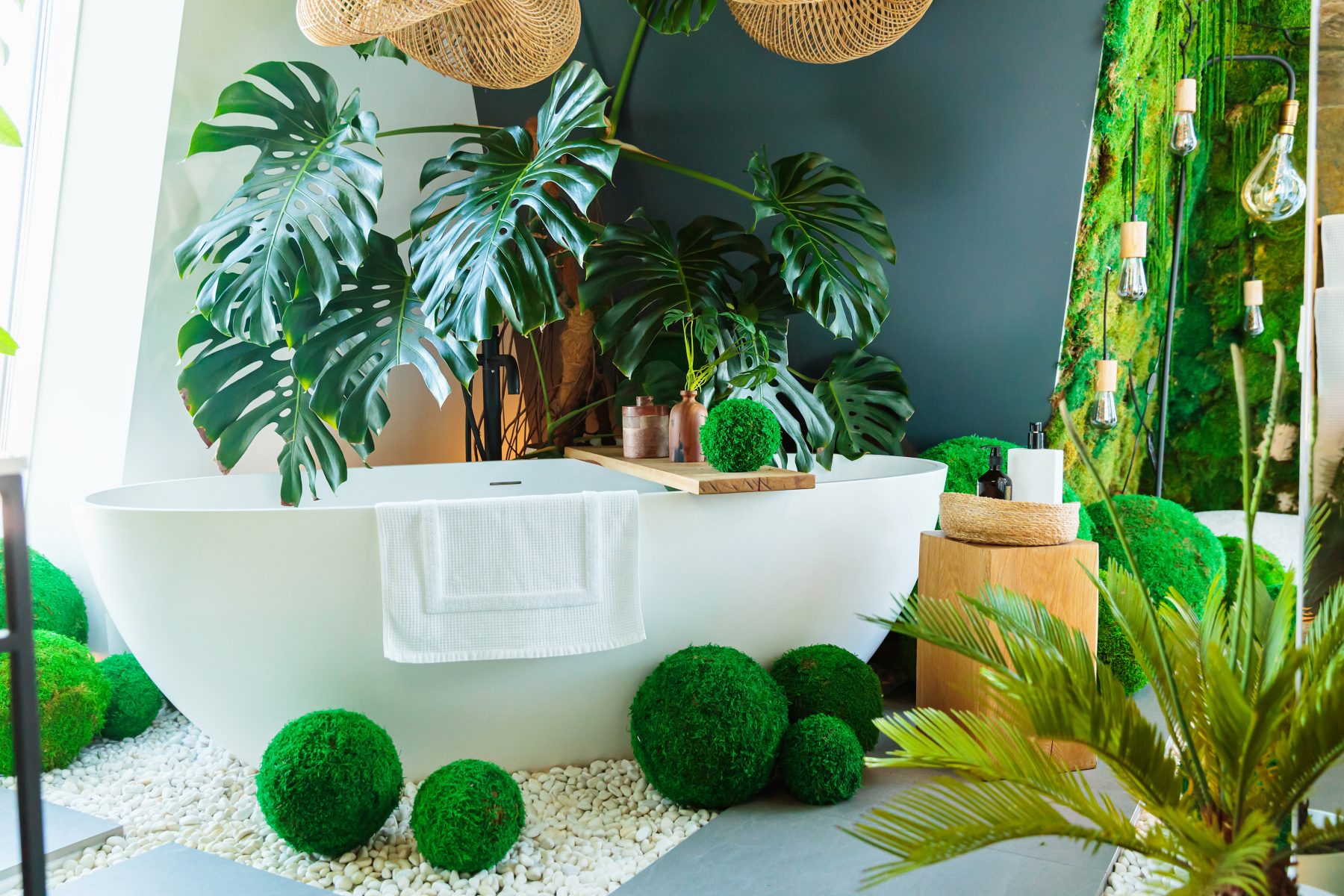
Many people incorrectly believe that bathrooms are too humid and have insufficient light for plants. While it is true that bathrooms are humid — and that is beneficial for many plants — and whilst it is true that bathroom lighting can be limited — there are plants that grow extremely well in humid and low light conditions.
Pothos is a great example of a plant that thrives in bathrooms. Philodendron is another. Ferns adore bathroom humidity. Snake plants tolerate bathroom conditions much better than most people realise.
Adding a single statement plant to a shelf or in a corner of a bathroom changes how you perceive the space. Avoid having multiple plants — ideally, keep the number of plants to one or two at most. Plants provide visual interest. They purify the air — which is important in bathrooms. They provide a living element that communicates a connection to nature.
If you are concerned about the upkeep, choose a pothos or another easy-to-care-for option. Pothos and similar plants can tolerate neglect and humidity equally well. Simply ensure you place the plant somewhere it will not get consistently splashed (i.e., away from the shower) and that you have at least some light source available (even if it is not strong).
Decorative Water Features and Moisture Management
You don’t need to add decorative water features to your bathroom. You already have water in your bathroom from the shower, the bathtub, the sink. However, you do need to manage the moisture responsibly.
Proper ventilation is essential — not only for managing moisture but for improving air quality. An extractor fan or openable window prevents excess moisture from developing into mould or mildew, thereby undermining the biophilic experience.
Other than proper ventilation, the mere presence of water in the bathroom itself (the shower, the tub) is a contributing factor to the sensory experience of the bathroom. A rainfall showerhead provides a distinct sensory experience compared to a standard showerhead. The sound and sensation of water falling creates a rainstorm experience. If you can afford it, this is a worthwhile expense. If you cannot afford it, it is not necessary.
Implementation Throughout Various Scenarios
Full Bathroom Renovation (With Budget)
Begin with lighting. Consider adding natural light if possible (through a window or skylight). For artificial lighting, install warm-toned light bulbs and consider dimmable lighting options. Budget: £200-500.
Next, address the materials used in the space. Choose wood or wood-textured engineered wood for the vanity (£400-1,200). Use large-format tiles or natural stone for the flooring (£800-2,000 depending upon the area). Choose natural textiles — towels, a bath mat, a shower curtain — in warm colours or greens (£100-300).
Finally, select a colour palette for the walls. Choose one or two walls in sage green or warm neutrals (£100-200 for paint and labour). Optionally, install a rainfall showerhead (£150-400).
Add a single statement plant (£30-80).
Total investment: £1,780-4,480. You are creating a completely different space. One in which you will actually want to spend time — not just quickly move through.
Limited Budget Updates (£300-800)
First, focus on lighting. Replace the bulbs with warm-toned, full-spectrum options. Install a dimmable light fixture if possible. Cost: £150-300. This immediately changes the appearance and natural feel of everything else in the bathroom.
Second, paint one accent wall in sage green or warm neutrals. Cost: £80-150. Instantly different.
Third, use natural textiles. Purchase new towels and a bath mat in natural fibres or greens. Cost: £50-150. Each time you interact with these materials, your nervous system recognises the difference between synthetic and natural materials.
Fourth, purchase one easy-to-care-for plant — such as a pothos or philodendron. Cost: £20-40. A living element that doesn’t require constant care.
Total investment: £300-640. Tremendous impact for very little money.
Renting or Making Limited Changes (£100-300)
Replace the light bulbs with warm-toned, full-spectrum options. Cost: £40-80. Immediate impact.
Choose a removable wallpaper in a single accent wall in green or warm tones. Cost: £30-80. Remove the paper when you vacate.
Purchase new towels and a bath mat in natural fibres or greens. Cost: £40-100. The tactile experience of these materials is substantial.
Purchase a single easy-to-care-for plant — such as a pothos. Cost: £15-30.
Total investment: £125-290. Substantial differences made with minimal budget and without any permanent changes.
The Details That Will Make the Difference
While larger elements contribute to the overall biophilic design of a bathroom, smaller details also contribute to creating a cohesive biophilic experience. Instead of purchasing a plastic soap dispenser, purchase a wooden one. Choose a natural fibre bath mat instead of a synthetic one. Install stone or wood accents on your vanity.
Each of these choices is not crucial on its own, but together, they communicate that every design decision in the space was thoughtful and deliberate. Your brain registers that. Your nervous system responds.
Mirrors deserve special consideration. Mirrors with natural wood frames provide a different sensory experience than frameless or chrome-framed mirrors. Strategically placed mirrors provide the benefit of reflecting light (particularly natural light if you have a window) and make the space appear larger and brighter.
Measuring the Effect of Design on People
You will likely see a difference after using a new biophilic bathroom for about 1 to 2 weeks. Your morning routine will be less stressful; evening baths or showers will be more relaxing. You will spend a little longer in the space. The reason is not that you have to stay longer. It is simply because you enjoy being in the space.
At the end of 4 to 6 weeks, you will probably miss these benefits if you had to go back to a regular clinical bathroom. Your body’s systems (your nervous system) will have adjusted to the restorative environment provided by the biophilic bathroom.
Common Mistakes to Make When Implementing Biophilic Bathroom Design
Ignoring lighting. If the lighting in the biophilic bathroom is too bright or uses too much fluorescent light, the space will feel as clinical as a traditional bathroom. Lighting is essential to creating a successful biophilic design.
Overusing plants. Too many plants make a bathroom appear cluttered and may create problems with moisture. Use no more than 2 plants.
Using cheap “natural” looking materials. Using laminate that appears to resemble wood but clearly does not is actually worse than using actual natural materials or high-quality engineered natural-looking materials.
Not providing adequate ventilation. Moisture without good ventilation leads to mould growth which ruins the entire purpose of a biophilic design. Good ventilation is required to provide a healthy biophilic design experience.
Viewing the biophilic bathroom as an aesthetic addition rather than as part of a functional system. A biophilic bathroom is not just decorative because it has a living plant and a piece of wood in the form of a vanity. It is biophilic when every aspect of the bathroom – lighting, materials, colour, air quality, and sensory input – works together to create a restorative environment.
Why This Applies
Your bathroom is probably one of the only truly private spaces available in today’s fast-paced society. It is typically where we have some real alone time. As such, making your bathroom a biophilic space (a space that is connected to nature, restorative, aesthetically pleasing) directly affects your level of daily stress, your level of sleep quality and your recovery from negative events.
An un-biophilic bathroom keeps you in a state of constant low-level alertness even when you are trying to unwind. A biophilic bathroom helps your body’s systems transition to a parasympathetic response. That is not something that is nice to have. That is true well-being.
Whilst a significant amount of money does not need to be spent, investing in even the smallest changes (e.g., better lighting, one accent wall in green, natural materials and textiles) results in a measurable difference in how you feel. Begin with what you can do now. Note the difference. Continue to build from there.

Sarah is an interior designer who specializes in biophilic design (the connection of humans and nature) and small-space living for urban apartment dwellers. Since working as an interior designer for 12 years, she has redesigned hundreds of flats in London, Manchester and Bristol. As such, Sarah is experienced in creating biophilically connected spaces in areas of homes that appear to be nearly impossible to redesign.
Sarah offers practical interior design solutions for both renter and homeowner, both with very real constraints: limited budget, inability to make structural changes, and every square inch of the home counts. Sarah’s methodology takes the principles of biophilic design and applies them to the realities of living in an urban environment. She has helped numerous clients create biophilic elements in compact, climate-controlled environments – humidity control in loft conversions, increasing daylight in basement conversions, adding biophilic elements in studio apartments that have no wall space.
The basis of Sarah’s philosophy is that biophilic design should not cost a fortune nor require a renovation. Rather, through a series of intelligent decisions, small choices can add up to large results. Sarah writes for people looking to transform their space in a way that does not require landlord approval, nor does it need to be expensive. Her guidebooks are focused on what actually works within the confines of typical UK flat designs, what investments will pay off, and what can be skipped altogether.