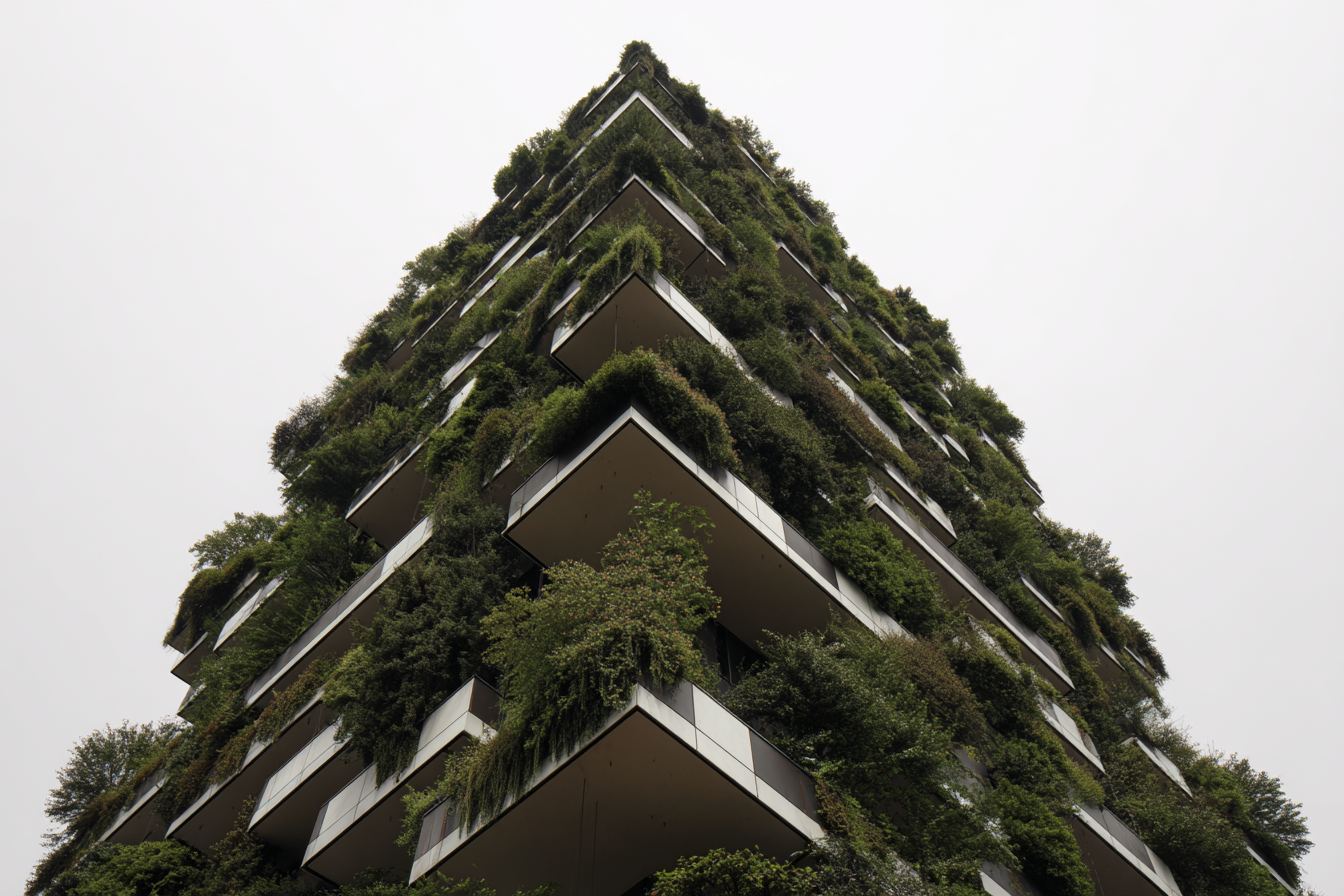
The Bosco Verticale (Vertical Forest) is a biophilic design in architecture, and there is a point in time when you will see Bosco Verticale in Milan for the first time when you cease thinking of it as a building and begin to think of it as a forest. Two towers rise 111 metres and 76 metres above the Milan skyline, respectively, and are covered in what appears to be a great deal of real trees. Over 900 trees and 20,000 plants. These are not simply decorative plants or greenery used for ornamentation. Rather, the trees and plants are an urban forest that contributes to air quality, biodiversity, and regulating the microclimate.
When I first evaluated this project, what impressed me was not the magnitude of the project’s goals. Rather, it was the audacity of the question it posed: Can we stop seeing buildings as obstacles to nature and start seeing them as a part of nature? What if we could create vertical forests that did not merely appear “green” but actually functioned as legitimate ecosystems?

Bosco Verticale is fundamentally distinct from “green washing” and decorative environmentalism. Instead, it is a working example of vertical biophilic architecture that incorporates living systems at a meaningful scale. The sheer number of plants and trees in the project is impressive, but the idea behind the project is simple: bring the forest to the city vertically.
The Scale of the Concept
Torre E 111 metres, Torre D 76 metres, with balconies cantilevering 3.25 metres with irregular projections. These are not merely decorative overhangs. Instead, they are load-bearing elements designed to hold mature trees.
480 large trees, 300 medium and small, over 90 species, 4,500-5,000 shrubs, 11,000-20,000 perennials and groundcover, equivalent to 1-5 hectares of forest area compressed onto 1,000-3,000 square metres of surface area. That is forest density vegetation attached to the vertical envelope of a building.
400 residential units, 22,000 sqm rentable. One of the most interesting aspects of the project is the ratio of greenery to population. Approximately one square metre of greenery exists for every two residents. This is not merely incidental landscaping. Rather, it represents a fundamental commitment to biophilic living at scale.
Environmental Benefits That Are Quantifiable
The environmental benefits claimed regarding Bosco Verticale have been criticised as “greenwashing,” however the metrics regarding the project are substantial. 19,000-30,000 kg CO2 absorption yearly, whilst also producing 3,500 cubic metres of oxygen per year. In cities such as Milan, with serious air quality issues resulting from industrial activity and vehicle emissions, this represents a tangible contribution to the overall atmospheric chemistry.
Energy savings of 7.5 percent, temperature reductions of 2-3 degrees Celsius compared to buildings without vegetation on their exterior surfaces, and reductions in surface temperatures of up to 30 degrees Celsius, representing 2-3 degrees Celsius of urban heat island mitigation throughout the microclimate surrounding the building. Whilst neither of these metrics represent extraordinary figures individually, together they illustrate that the creation of vertical vegetation results in quantifiable environmental benefits.
5,700 cubic metres water yearly, with 100 percent of that water being sourced from non-potable sources. The building also captures and filters particulate matter and fine dust from the ambient air. Additionally, the building reduces noise pollution. Withstands wind forces up to 67 m/s.

Biological Diversity As A Design Outcome
In addition to the intended vegetation, Bosco Verticale has evolved into an unintentional habitat for numerous species of biological diversity. 1,600 birds and butterflies, 90+ species, along with 60 varieties of trees and 94 varieties of plants total, and utilised 1,200 ladybugs to help control pest populations without the use of chemical pesticides.
The ability of Bosco Verticale to host biodiversity was not a stated design goal in the original project brief. Rather, it emerged as a result of creating an actual habitat for wildlife within the urban environment. The presence of birds created habitat for predatory insects. The system became functional as an actual ecosystem rather than as a decorative element. The distinction here is between true biophilic design and superficial decoration.
Economic And Engineering Challenges
€65 million total, €1,950 per sqm, with apartment units ranging from €10,000-€15,000 per square metre upon completion in 2016, with annual maintenance and service costs of approximately €65 per square metre.
The engineering challenges associated with this project involved the installation of mature trees (which range from 3-9 metres in height) via crane, not saplings that would require decades to establish. The balconies are pre-stressed concrete terraces designed to bear the loads of soil, water, and mature vegetation. The deep seismic piling of the towers provides additional stability to the structural system. This is not simply light-weight “green-washing”. Rather, it is a substantive structural investment in vertical ecological systems.
Designed 2009, built 2011-2014, as part of the larger €2 billion Porta Nuova urban redevelopment plan for Milan. Unlike conventional urban development that seeks to minimise its impact on nature, the Porta Nuova master-plan incorporated biophilic design as a primary aspect of the plan, rather than as an after-thought. This enabled the realisation of substantial environmental and social benefits.
Awards And Influence
International Highrise Award 2014, Best Tall Building Europe award from the Council on Tall Buildings and Urban Habitat (CTBUH) in 2015, and LEED Gold Certification in 2015. These are not niche environmental awards, but rather mainstream architecture awards from the top tier of the industry.
More importantly than the awards themselves, Bosco Verticale initiated a global discussion among architectural firms about vertical greening. Prior to the construction of Bosco Verticale, vertical greening was a fringe concept. Following the completion of Bosco Verticale, numerous major architectural firms began questioning whether buildings could make active contributions to urban ecology, or merely attempt to reduce their negative impacts. The architect, Stefano Boeri, has subsequently designed or proposed vertical forest projects in Nanjing, Shanghai, Mexico City, and Paris, illustrating that the Milan-based model is replicable at a variety of scales and in a variety of climates.
Maintenance And Horticultural Management Of The Project
Whilst visually stunning, Bosco Verticale represents a complex, long-term maintenance programme that many potential future iterations of this type of project may overlook. The €65 per square metre annual service cost includes specialised pruning techniques to prevent trees from obscuring views or destabilising the structural system, biological pest control methods to prevent the need for chemical pesticides, maintenance of the water system, including recycled groundwater filtration and solar pumping, regular monitoring of soil conditions and amendments, identification and treatment of diseases affecting the vegetation, and coordination with structural engineers to monitor the structural integrity of the cantilevered balcony system.
To accomplish these tasks, the project employs horticultural staff with extensive experience with vertical growing systems, arboriculture specific to constrained growth conditions, and an understanding of the unique microclimatic conditions present at elevated heights, where wind, temperature, and humidity are substantially different from those present near ground level. This is not merely maintenance carried out by a typical building management company. This requires highly specialised personnel.
This level of sophistication in ongoing maintenance is part of why the project has not been replicated on a global basis. Most cities and developers do not possess the same level of horticultural expertise as that represented by the staff employed by the developer of Bosco Verticale. Whilst it is possible to learn and develop this expertise, it requires an explicit and intentional commitment of resources.
Bosco Verticale illustrates that when the vision is maintained over decades, rather than compromised within the first five years, investing in the development of this expertise is worthwhile.
Distinction Between Bosco Verticale and Decorative Green Facades
One of the primary distinctions between Bosco Verticale and decorative green facade systems is often misunderstood by developers and architects who are attempting to rapidly acquire environmental credibility. Many buildings incorporate greenery as a surface treatment — living walls that appear impressive in marketing renderings, yet provide limited environmental benefit and typically require significant amounts of mechanical maintenance that undermines environmental claims.
In contrast, Bosco Verticale has planted actual trees that include substantial root systems in suitable soil. The vegetation is not reliant on automatic irrigation systems (although these do exist as backups). The balconies serve as actual habitat space with depth, soil volume, and conditions that allow ecosystem development. The trees grow and mature, providing shelter and sustenance for birds and insects over extended periods. The system self-regulates over time, rather than remaining static or needing continuous intervention to prevent collapse.
Construction and long-term maintenance of Bosco Verticale are both costly endeavours. Structural engineering expertise at the highest levels is necessary to achieve successful construction. Long-term horticultural expertise is needed to sustain the project over the course of the building’s operational life. However, when these criteria are met, the resulting project produces something fundamentally different from decorative green facades — a living building that is an integral component of urban ecology, and whose occupants perceive it as a genuine connection to nature, rather than simply a visual façade.
Replication and Climate Adaptation
Is it possible to replicate Bosco Verticale on a global basis? Whilst the structural engineering principles are replicable — cantilever design, load calculations, seismic considerations — the horticultural approach is replicable as well. The water management systems are replicable. However, the economics of the project pose challenges in regions where €10,000 per square metre sales prices do not support the €65 million construction expenditures, and the complexity of the long-term maintenance requirements limits scalability in affordable housing applications.
Climate plays a role in implementing the Bosco Verticale model. Cities with temperate climates, such as Milan, support Mediterranean and temperate tree species at height where wind and temperature extremes are greater than at ground level. Tropical climates would necessitate the use of different tree species, and possibly more intense watering strategies. Desert climates would necessitate completely different approaches to water management — possibly through the use of greywater reuse rather than groundwater harvesting. The model can be replicated at differing scales and climates, although the specific implementation will require considerable local adaptation and horticultural expertise.
Boeri Architects’ subsequent projects in other cities have successfully adapted the structural and horticultural systems developed for Bosco Verticale to accommodate various climates. The basic concepts — load-bearing balconies designed to support vegetation, sufficient soil depth, local tree species, integrated water management systems — can be applied across varying climatic zones. Economic factors — specifically the premium market position that is required to justify the considerable expense of constructing and maintaining the project — currently limit replication globally.

What Bosco Verticale Demonstrates
Bosco Verticale illustrates three fundamental truths about urban design and biophilic architecture:
Firstly, it demonstrates that vertical biophilic design at a meaningful scale is technologically feasible. The engineering challenges of the project are surmountable with sufficient expertise and commitment.
Secondly, it demonstrates that this approach has environmental benefits that are quantifiably measurable — not merely aesthetically or psychologically, but in terms of carbon sequestration, oxygen generation, thermal regulation, and urban heat island mitigation.
Thirdly, it demonstrates that this approach is economically viable in premium markets where residents are willing to pay significant premiums to live in environments that emphasise biophilic living.
Ultimately, Bosco Verticale demonstrates that buildings can be designed to function as habitat, not merely as habitat replacement. Conventional urban development attempts to minimise the impact of nature. Bosco Verticale seeks to integrate nature into the structural fabric of the building itself. It demonstrates that when mature ecology is integrated into the structure of a building and inhabited by humans, the spaces created are valued by individuals to the extent that they are willing to pay significant premiums to inhabit them and to recommend them to others.
Most importantly, Bosco Verticale addresses the fundamental question that underlies urban design — namely, what if cities did not have to choose between density and nature? What if tall buildings could contribute to urban ecology, rather than competing against it? What if increased urban density resulted in increased urban forests, rather than decreased ones? Bosco Verticale demonstrates that this is not merely a theoretical possibility. It is a realised possibility that is measurable in terms of both environmental and social benefits.
The project does not address all the questions related to sustainable urban development. The embodied carbon contained in the concrete structure is considerable and must be considered in terms of offsets. The maintenance complexity restricts application to premium residential markets, limiting scalability in affordable housing applications. The project required a considerable investment and technical expertise that many cities lack or do not prioritise. Nevertheless, the project represents a proof-of-concept for vertical biophilic architecture at a meaningful scale. It illustrates that when a genuine commitment to integrating living systems into buildings is made — rather than simply superficial green-washing — the resulting environmental and human benefits are measurable and considerable. This proof-of-concept is influencing how cities around the globe view the relationship between urban density and ecology.

Tom is a landscape architect and sustainability consultant who specializes in integrating biophilic design with environmental responsibility. He’s spent 10 years designing projects that don’t just bring nature indoors but do so in ways that support broader ecological goals.
He’s frustrated by “greenwashing” biophilic design—adding plants sourced unsustainably, using materials with massive carbon footprints, creating maintenance systems that drain water resources. His work focuses on creating beautiful, functional biophilic spaces that actually reduce environmental impact rather than increase it.
Tom writes about sustainable material selection, native planting strategies, water management in biophilic systems, and how to build green features that support local ecology. He’s interested in the intersection of human wellbeing and environmental health—the idea that spaces designed to connect us to nature should also genuinely support nature. His guides are for people who want biophilic design to align with their environmental values, not contradict them.